The European Commission president has said Brussels will launch a proposal for the introduction of digital vaccine passports for use across the bloc in March, after the German chancellor said it should be ready by the summer.
“As for the question of what the digital green passport could look like, we will submit a legislative proposal in March,” Commission President Ursula von der Leyen told German conservative lawmakers on Monday.
Von der Leyen’s remarks came after German Chancellor Angela Merkel claimed that the vaccine passport would be ready in time for the summer, with a number of southern European states championing the scheme as a way of reopening the tourism industry.
“In the future, it will certainly be good to have such a certificate but that will not mean that only those who have such a passport will be able to travel; about that, no political decisions have been made yet,” Merkel added following last week’s virtual leaders’ summit.
Merkel also highlighted that too few people had been vaccinated in the bloc to consider introducing the digital passport in the near term.
Around 30 million Covid-19 jabs have so far been administered across the EU, a fraction of the bloc’s 446 million inhabitants. Meanwhile, the UK alone has administered almost 21 million vaccines.
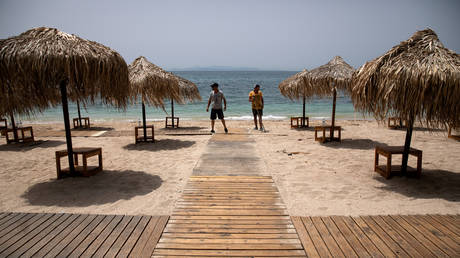
Negotiations have already begun between nations to get tourism and travel moving again. In mid-February, Haris Theoharis, the Greek tourism minister, confirmed that negotiations had kicked off with his UK colleagues to allow holiday travel to return safely between the two nations, with an expedited process for those who have been vaccinated.
Greece has already signed an agreement with Israel to allow vaccinated people to move freely between the two countries. Such accords are important for the Greek economy, which is heavily reliant on tourism revenue.
Paulo Costa had a novel excuse for his unusually tepid performance in his world title bout against Israel Adesanya, earning derision for admitting that he was "hungover" from a full bottle of wine he had drunk hours beforehand.
Brazil's Costa surrendered his unbeaten professional record when he was beaten by middleweight champion Adesanya in Abu Dhabi last September, but more more disappointing than the result was the performance of the usually ferocious slugger.
Rather than hunting down his opponent as he had done in his previous 13 fights, Costa stayed at range and presented an easy target to the laser-sighted Adesanya.
Costa initially pointed to less-than-ideal scenarios in preparation which had hindered his performance, at the time suggesting that a lack of sleep was a significant factor.
Lmfao Costa said he Drank a whole bottle of wine before the night before the fight to go sleep, was drunk when he fought, Leg cramps, didn't fight properly because he was too calm, was sleepy and yawning the whole time and had many other factors going into the fight??? 🧐 pic.twitter.com/mPKa8uSh6Y
Several months on from the world title fight, he now says that he probably shouldn't have drank a bottle of wine the night before the fight.
"I was kind of drunk [when] I fought, maybe, on hangover," Costa said on his YouTube channel (via translation).
"I couldn’t sleep because of [leg] cramps. Keep in mind that the fight happens at 9am [local time]. We have to wake up at 5 to get ready, stretch, wrap the hands.
"The UFC told us to wake up at five in the morning to go to the arena to fight. I hadn’t slept until 2.30.
"It was my mistake and I don’t blame anyone else. It was something I chose [to do] but, in order to try to sleep, because I had to sleep since I had been awake for 24 hours, I had wine – too much wine, a bottle [of wine] to try to black out.
"I had a glass and it didn’t work. Two glasses, it didn’t work. Half bottle, didn’t work. I had it all."
Costa, who lost by second-round knockout in the fight, had previously admitted that he should have sought to postpone the fight for a week given his problems sleeping. He elaborated in the video about exactly how he felt in the cage after his pre-fight bender.
"It was a different feeling,” he said in the video. "I’m always very active in every fight.
"There’s some apprehension, fear of getting hit and whatnot, so you’re on. In this fight, the championship fight, I was sleepy, yawning and unworried.
"It was odd. I didn’t feel anything, not even an agony, ‘Wow, I’m fighting for the title.’ Not even that. I was too calm. All that calm freaked me out."
Listeners were predictably unconvinced. "What a cry baby," retorted MMA fighter Ramsey Nijem. "You drank the wine and got f**ked. You’re not the first."
"So the night before the biggest fight of his career he 'drank too much wine'," said one fan, while others compared Costa's surprising explanation to the roundly-discredited reasons given by former boxing champion Deontay Wilder for his knockout defeat against Tyson Fury last year.
"The fight that would've not only made him a UFC champion but also dethroned a fighter who many before him couldn't, and that's how serious he took it. He should never be given another shot at the title."
Costa will get his opportunity to rebound from the Adesanya loss when he fights former 185lbs titleholder Robert Whittaker in a five-round main event on April 17 – when Costa promises we will see the return of the man who fought his way to title contention, rather than the person who ultimately surrendered the opportunity.
"It will be the same Paulo of always, going for the knockout at all times. I haven’t changed," he said. "The thing is, I was 20, 10 percent of my capacities in the Adesanya fight.
"We had to change the the strategy in the locker room – 'don’t attack him, just wait for the first two rounds' – which was a mistake. Today we know that was a mistake, but talking is easy."
New data from the Australian National University (ANU) showed Chinese investment in Australia dropped by more than 61 percent in 2020, to just over a billion Australian dollars (US$780 million) – the lowest in the past six years.
According to figures from the Chinese Investment in Australia Database (CHIIA), the drop followed a 47 percent fall in 2019, when Chinese investment totaled US$1.57 billion. It was also well short of the peak of US$12.7 billion recorded in 2016.
“It reflects the effects of Covid, but also more scrutiny of foreign investment by the Australian government, particularly that from China,” said Shiro Armstrong, Director of the East Asian Bureau of Economic Research, where CHIIA is based.
The number of Chinese investments recorded was only 20 – well down from a peak of 111 investment projects in 2016, the ANU said.
According to the research, 45 percent of the Chinese investment last year was in rental, hiring, and real estate services, while 40 percent was in mining and 15 percent in manufacturing. Other sectors, including transport, energy, construction, healthcare, and agriculture, which had seen Chinese investment in previous years, recorded none in 2020.
The ANU also found that, in 2020, about 86 percent of Chinese investment in Australia originated from Chinese companies already established in the country, which means purchases were made via Australian subsidiaries rather than directly by Chinese companies.
Armstrong told the Xinhua news agency that the investment environment in Australia “has become more uncertain,” adding that the decline of Chinese investment could result in lower asset values in Australia from removal of a large source of capital and a large bidder, as well as the retreat of economic integration between the two nations. “Foreign investment increases trade and can act as a ballast in relations between countries,” he said.
Economic tensions between China and Australia have escalated in recent years after Australia began cracking down on Chinese investment in the country. Relations deteriorated further after Australia banned Chinese telecoms Huawei and ZTE from its 5G rollout. Tensions were raised again last year, when Australia called for an international inquiry into the origins of the coronavirus outbreak, prompting accusations from Beijing that Australian lawmakers were acting on orders from Washington.
In response, China has imposed trade tariffs on Australian goods, including barley, wine, beef, and lobster.
By not deleting banned material, Twitter has ‘maliciously violated’ Russian law. That’s according to media regulator Roskomnadzor, which has revealed that the tech giant has refused to remove 2,862 posts with illegal content.
On Monday, the watchdog revealed that it had sent the California-based company a combined total of 28,000 deletion demands, with around 10 percent being refused. These include 2,336 posts on suicide, as well as 352 containing pornographic images of minors.
According to Russian law, violating the rules governing the restriction of access to illegal content could see the firm hit with a fine of up to 8 million rubles ($110,000), with that amount increasing to one-fifth of the company's annual revenue for a repeat offense.
As of February 1, according to new Russian legislation, social networks are now required to identify and block the forbidden content themselves, and have an obligation to take immediate measures to restrict access to prohibited material. As well as posts that call for terrorism, promote violence, and call for unsanctioned protests, the law also includes content with bad language.
This is not the first time Twitter has fallen afoul of Roskomnadzor in recent weeks. On Tuesday, the social network decided to remove 100 accounts it alleged were linked to the Kremlin, claiming that 69 of these had been deleted for "undermining faith in the NATO alliance," which raised eyebrows among journalists, with a further 31 banned for "targeting the United States and European Union." In response, the regulator demanded a list of all the affected users with explanations for why they'd been blocked. Among the suspended accounts include the Valdai Discussion Club, one of Russia's top think tanks.
Twitter was also slammed by Ministry of Foreign Affairs spokesperson Maria Zakharova, who called the social network "a tool of global digital diktat in the hands of the Western establishment" and no longer an "independent discussion platform."
While popular in the West, Twitter is only the eighth most used social network in Russia, behind the likes of International platforms YouTube (35 percent) and Instagram (31 percent), as well as domestic websites VKontakte (43 percent) and Odnoklassniki (31 percent).
While some see Russia's actions against Twitter as toothless, politicians have repeatedly threatened to outright block foreign social media firms that are perceived to discriminate against Russian outlets. In November, MP Alexander Khinshtein and influential Senator Alexey Pushkov proposed punishing social networks that display prejudice on the basis of nationality, language, or anti-Russia sanctions. If found guilty, the websites could be fined or even blocked entirely. The proposal came after Twitter took action against RT and other publicly-funded Russian media outlets, subjecting their accounts to a shadowban.
Speaking to Moscow-based news agency TASS last year, MP Anton Gorelkin explained that the proposed legislation would give the government the right to throttle a website's speed.
"Access restriction, which includes slowing down traffic, is intended as an extreme response against the blatant discrimination against Russian media outlets on foreign platforms," Gorelkin explained. "I have always been a proponent of soft power and an opponent of blocking, but the state should always have a hard option in reserve for particularly malicious violators of the law."
Think your friends would be interested? Share this story!
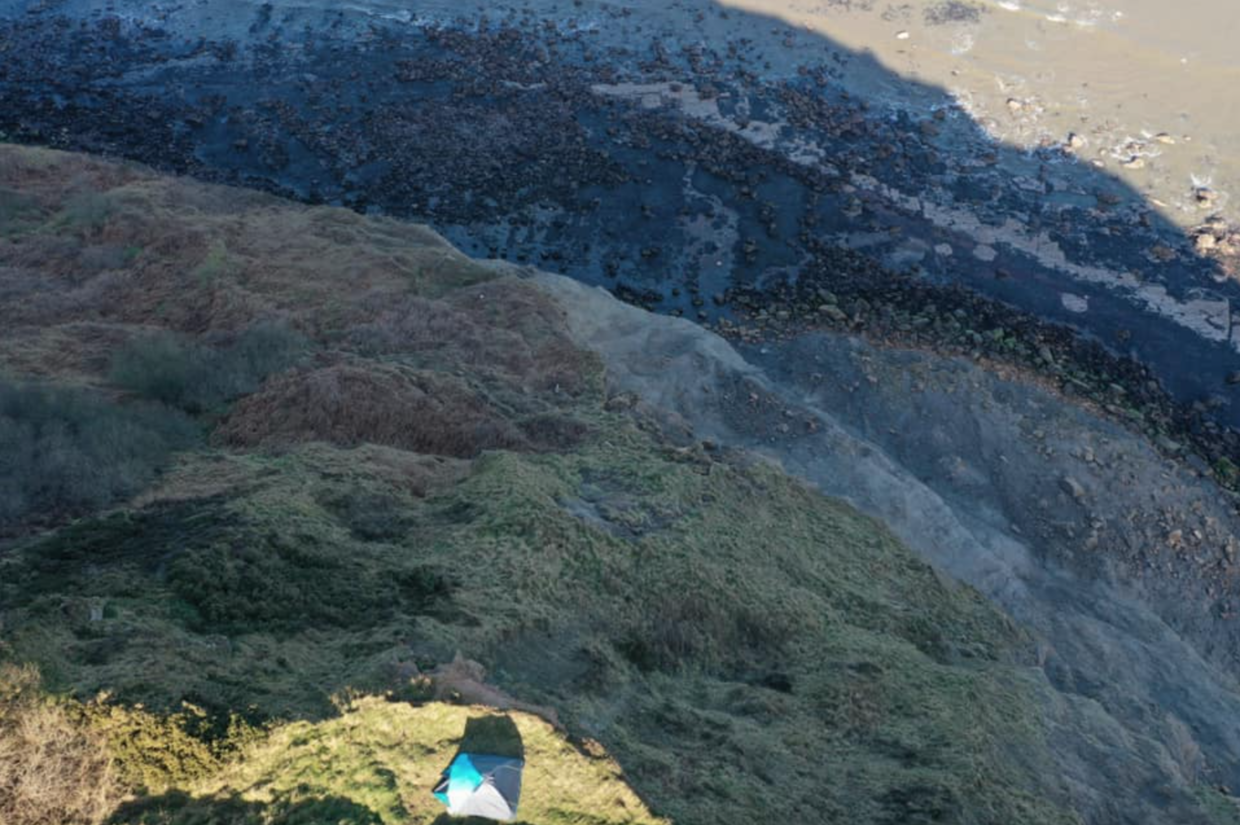
Police and coastguard officers responded to a call after a couple were spotted camping on a cliff edge with their young child, in contravention of lockdown rules and, arguably, common sense.
Rescue teams from Staithes and Whitby coastguard agencies, along with responding police officers, happened upon the couple’s tent on Cleveland Way in North Yorkshire on Saturday.
https://ift.tt/3q5nNPh
The police were called as the family had breached Covid restrictions, though it is unclear whether or not they received a fine. Overnight stays away from a person’s primary residence are illegal under current UK coronavirus lockdown restrictions, even if it is in the great outdoors.
The couple were issued with safety advice by the coastguard officers due to the dangerous location of their tent, especially in light of recent landslips in the area.
The response to the news on social media was one of irritation and consternation, prompting comments such as “Words fail me” and “Some folk are just born stupid.”
“Hope they don’t sleep walk,” one Facebook user quipped. “Bonkers and utterly thoughtless. Putting themselves and others at risk,” added another.
To put that risk in perspective, a section of cliff weighing over 200 tonnes fell onto the beach below at Runswick Bay in early February.
https://ift.tt/3r0ZBi6
“A cliff fall comes with no warning, and being on the receiving end of even a small avalanche can be fatal,” Staithes Coastguard said.
Tehran has dismissed claims made by Israeli PM Benjamin Netanyahu that Iran was behind an attack on an Israeli merchant ship in the Gulf of Oman last Thursday, adding that security in the region is just as important for Iran.
“The Persian Gulf and the Sea of Oman are Iran’s immediate security areas,” Foreign Ministry spokesman Saeed Khatibzadeh told reporters on Monday, adding that Tehran would not allow these priorities to be undermined by Israeli accusations.
Khatibzadeh lambasted Israel for its “incorrect” claims that Iran was behind last Thursday’s attack on the vessel.
Not only do we strongly reject this accusation, but we also reject and closely monitor Israel’s actions in the periphery in recent months
“Netanyahu suffers from an obsession with Iran and thinks it is the cause of their internal problems,” Khatibzadeh claimed, adding that if Israel wished to lay the groundwork for new tensions, Iran would “follow it up.”
The spokesman sought to clarify Iran’s positive influence on security in the Persian Gulf, adding that Tehran’s decision in late 2020 to seize a South Korean tanker was a legitimate action to help with legal proceedings.
Speaking earlier on Monday, Netanyahu said Iran was “clearly” behind an explosion on the Israeli-owned MV Helios Ray on Thursday evening.
“Iran was behind the attack on an Israeli ship this weekend in the Gulf of Oman,” the prime minister told the Israeli Public Broadcasting Corporation, adding that Tehran was “Israel’s biggest enemy,” and his country was “beating it [Iran] all across the region.”
The Gab accounts of Donald Trump and Gab’s own CEO are among those “compromised” by a hack of the microblogging service popular among US conservatives and right-wingers. The data is being offered to researchers and journalists.
A 70-gigabyte trove of data dubbed “Gableaks” includes public posts on the platform, but also “private posts, user profiles, hashed passwords for users, DMs, and plaintext passwords for groups,”according to an entity called DDoSecrets. The information was allegedly stolen by a third party and leaked to the group, which operates similarly to WikiLeaks. The leak was described in detail by Wired, which was given access to a sample of the dataset.
The transparency group #DDoSecrets will make the 70GB of passwords, private posts, and more available to researchers, journalists, and social scientists.
— Emma Best 🏳️🌈🏴 Demon Hacker (@NatSecGeek) March 1, 2021
Gab is a competitor of Twitter that caters to users who feel their freedom of speech is being unduly restricted by Big Tech. Critics call it a hotbed of far-right extremism that is flourishing thanks to the company policies encouraging user anonymity and a lack of content moderation.
Like it's better-known counterpart Parler, Gab saw an influx of new users after Silicon Valley launched a crackdown on undesirable voices in the wake of the January 6 riot at the Capitol. When Parler was effectively deplatformed shortly afterwards, some of its users went to Gab.
The Gableaks trove “contains pretty much everything on Gab, including user data and private posts, everything someone needs to run a nearly complete analysis on Gab users and content," DDoSecrets cofounder Emma Best told the tech news website. “It's another gold mine of research for people looking at militias, neo-Nazis, the far right, QAnon and everything surrounding January 6.”
According to Wired, the data in DDoSecrets’ possession was obtained through a technique called “SQL injection,” which tricks a website into executing malicious code sent as user input. In a Friday statement, Gab said it was “aware of a vulnerability in this area and patched it last week.” DDoSecrets says the hacking was done by “JaXpArO (they/them) & My Little Anonymous Revival Project.”
After a Wired inquiry about the breach, Gab’s CEO Andrew Torba publicly presumed that the publication was “in direct contact with the hacker and [was] essentially assisting the hacker in his efforts to smear our business and hurt you, our users.” After the story was published, he lashed out at “mentally ill t****y demon hackers” and at DDoSecrets.
“The same people behind this attack targeted law enforcement officers and their family members last summer,” he wrote on Sunday. Torba was apparently referring to ‘Blueleaks,’ the 269-gigabyte trove of internal US law enforcement data that DDoSecrets helped disseminate in June and for which it is best known by the public. He claimed that “the feds are treating them as a criminal hacker organization.”
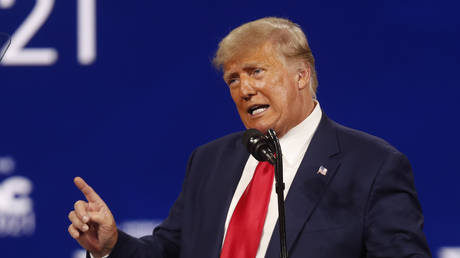
In its Friday statement, Gab downplayed the importance of the breach, citing its policy of not collecting user data that can help identify them and pointing out that the DMs feature was only available at the site for a short period of time. An update on Sunday said the company was “all hands on deck investigating what happened” and implied that the dump of the data was timed with Donald Trump’s speech at the CPAC in Orlando.
Wired said the hashed passwords in the dataset appeared to include those for Donald Trump, Republican ‘QAnon congresswoman’ Marjorie Taylor Greene, controversial MyPillow CEO Mike Lindell and radio host Alex Jones. The latter has the distinction of being deplatformed by tech giants in 2018 in an apparently concerted manner and similarly to Parler this year. Reportedly neither Wired nor DDoSecrets attempted to decrypt the passwords, which would allow access to the accounts.
It remains to be seen how much insight into Gab's user base the leak offers. For one, it helped social media researchers like Max Aliapoulios, who complained that the service was not stable enough to conduct collection of its public posts. The data, he told Wired, may help other companies censor on their platforms the type of speech that Gab allows.
New Zealand's Prime Minister Jacinda Ardern has urged obedient members of the public to call out violators of coronavirus rules, as it emerged people have been concealing Covid-19 contacts.
Speaking on Monday about recent Covid-19 cases that are linked to breaches of anti-coronavirus restrictions, Ardern aimed mighty jabs at rule breakers.
Even with the full understanding of human fallibility, it is not appropriate, and it is not okay for members of a team of five million to let the rest of us down.
Ruling out punishments for the violators handed out directly by the government, and citing the separation of police and state, the PM urged the public to take the matter into their own hands and “call out” any rule-breakers they spot, family and friends included.
“If there is any question mark right now over there being consequences, you know, those individuals are facing the full judgment of the entire nation. There are consequences, undoubtedly,” Ardern stated.
And if that means, calling a family member or a work colleague out for not following the rules, then we should do that.
The angry remarks from the PM come as it emerged that, in one of the latest coronavirus cases, the infected person had concealed their contacts from the disease tracers. Two women, one of whom had already been told to self-isolate, had gone for a walk together in defiance of the restriction.
“We have now confirmed how our latest case M and N came to be infected with Covid-19. That is because they had contact with another family that we had identified as part of the Papatoetoe cluster during level three,” Ardern told reporters earlier in the day. “I cannot tell you whether it was for fear that it occurred during level three or lack of memory.”
The new transmissions prompted the PM over the weekend to send the city of Auckland into a new seven-day lockdown within just one month. Employing tough restrictions and promptly squashing coronavirus clusters, New Zealand has fared quite well during the pandemic, detecting only some 2,300 cases, including 26 deaths.
Think your friends would be interested? Share this story!
The Foreign Correspondents’ Club of China (FCCC) has accused Beijing of using Covid-19 as “yet another way to control journalists,” curbing visas and surveilling reporters. China says it’s protecting its citizens from the virus.
The FCCC, which is the professional association of Beijing-based journalists reporting on China, has argued that 2020 had seen a “rapid decline in media freedom,” implemented under the cover of measures that were used to combat the spread of coronavirus.
In its annual report released on Monday the press group claimed these restrictions were placed on journalists to prevent them from providing an accurate picture of ongoing events in the country, as well as in other areas that are politically sensitive for Beijing, such as Tibet.
As China’s propaganda machine struggled to regain control of the narrative around this public health disaster, foreign press outlets were repeatedly obstructed.
The FCCC found that 42 percent of journalists who responded to the report had been denied access to or forced to leave areas because of claims of health concerns and threats of enforced quarantine. Some members of the media also argued that reporters had been subject to restrictions that did not apply to other individuals in the country, including contact tracing and checkpoints, which “created additional opportunities for Chinese authorities to gather data and surveil foreign journalists and their sources.”
China has previously refuted criticism of its strict Covid-19 restrictions, which have impacted diplomats, officials from the World Health Organization, and journalists entering and traveling around the country. Beijing believes tight controls, quarantines, and testing are required to protect its citizens from new variants of the virus that could quickly spread throughout China.
In January, China’s state-run press agency Xinhua announced that the country would be enforcing a ‘14+7+7’ policy that would oblige anyone entering the country to spend 14 days in hotel quarantine, seven days in home quarantine, and another seven days being monitored at home with limits on the ability to meet with others in public.
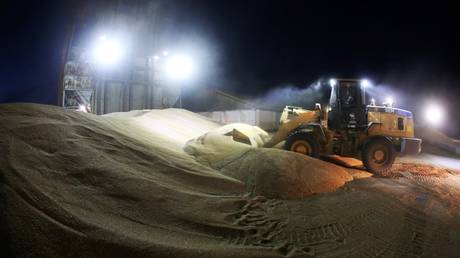
Export duty on Russian wheat has been doubled to €50 ($60.44) per ton from March 1. It will remain in force until a permanent floating tax is imposed in June.
The levy was introduced in February in a bid to protect domestic supply and stabilize the prices for flour and bread, and will be applied for certain grains under an export limit of 17.5 million tons for the remainder of the marketing year during the current season. The wheat tax does not apply to member countries of the Eurasian Economic Union.
The Russian authorities have also approved the raising of export tax on corn and barley to €25 ($30.23) and €10 ($12,09) respectively. Exports of Russian rye are not subject to the tax.
“The measure will reduce exports, and will help to refocus market players from selling agricultural commodities to exporting agricultural goods with high added value,” the government said in a press release.
The current measure will expire on June 2, when the so-called floating tax will be imposed on wheat, corn, and barley. The measure will oblige sellers to register their export contracts on the Moscow Exchange.
Under the floating tax system, the base price indicator for wheat has been fixed at $200 per ton, so it will kick in only if the calculated market benchmark price is above the $200-per-ton threshold. For corn and barley, the base price indicator is set at $185 per ton.
According to the government, the scheme will minimize the negative impact of the price fluctuations seen globally on Russia’s domestic market.
Indian PM Narendra Modi has received his first shot of the country’s domestically produced Covid-19 vaccine, Covaxin, kicking off the second stage of the nation’s massive inoculation drive, which is now focused on the elderly.
India entered its next stage of the mass-vaccination campaign on Monday, expanding the drive to include people aged over 60 and those over 45 who have chronic illnesses. The 70-year-old prime minister became the first person to get the jab at Delhi’s AIIMS hospital.
“Remarkable how our doctors and scientists have worked in quick time to strengthen the global fight against Covid-19,” Modi wrote on Twitter.
I appeal to all those who are eligible to take the vaccine. Together, let us make India Covid-19 free!
While Modi himself did not specify which vaccine he took, footage from the scene clearly shows it was India’s homegrown solution Covaxin. The drug, based on inactivated coronaviruses, was hastily approved for emergency use back in January.
Took my first dose of the COVID-19 vaccine at AIIMS.
Remarkable how our doctors and scientists have worked in quick time to strengthen the global fight against COVID-19.
I appeal to all those who are eligible to take the vaccine. Together, let us make India COVID-19 free! pic.twitter.com/5z5cvAoMrv
Despite receiving the approval, the vaccine’s manufacturer, Bharat Biotech, has still not submitted efficacy data of the ongoing Phase III clinical trials. This lack of data has prompted concerns over Covaxin’s safety and efficacy.
India began its massive vaccination drive in mid-January, using both AstraZeneca and Covaxin in the program. The first phase of the immunization drive focused primarily on healthcare workers. However, these turned out to be very reluctant to take Covaxin, with only some 11 percent of them opting for the domestically developed solution. Last week, India’s government said it would allow people to choose their vaccination centers, effectively enabling them to choose between AstraZeneca and Covaxin, which previously was not an option.
India has recorded more than 11 million cases of Covid-19 since the beginning of the pandemic with over 150,000 people succumbing to the disease. The country has set an ambitious goal of vaccinating a whopping 300 million people by August, more than a quarter of its massive 1.37 billion population.
Think your friends would be interested? Share this story!