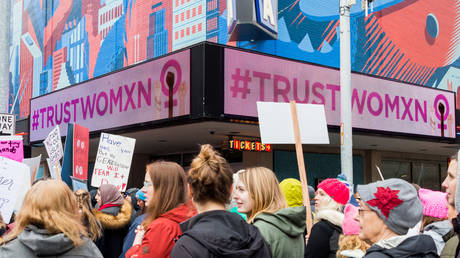
Streaming platform Twitch has returned to the conventional spelling for “women” after its social media post hailing “Womxn’s History Month” – avoiding any “gender-binary language” – backfired and angered critics on all sides.
Though the company took to Twitter on Monday to inform users that “March is Womxn’s History Month,” using an alternative styling of “women” in a bid to include non-binary gender identities, it made an abrupt about-face just a few hours later, announcing that it would revert back to the standard spelling.
“While we originally wanted to use a word that acknowledges the shortcoming of gender-binary language, after hearing directly from you, including members of the LGBTQIA+ community on Twitch, we will be using the spelling ‘women’ moving forward,” the platform said in a tweet, adding that the company is “still learning.”
We want to assure you that we have, and will continue to, work with the LGBTQIA+ community. We're still learning. Our good intentions don't always equate to positive impact, but we're committed to growing from these experiences, doing better, and ensuring we're inclusive to all.
We want to assure you that we have, and will continue to, work with the LGBTQIA+ community. We're still learning. Our good intentions don't always equate to positive impact, but we're committed to growing from these experiences, doing better, and ensuring we're inclusive to all.
It isn’t clear what prompted the sudden reversal, but the company’s initial, now-deleted post quickly triggered backlash, including from those identifying as transgender. Some argued that few actually refer to themselves as “womxn” and that the term instead makes “most trans women feel othered” rather than included.
“No one who's a woman wants to be called a womxn just like no Latinos want to be called Latinx. White liberals know what's best for us tho,” wrote trans YouTuber Blaire White, referring to another attempt to de-genderize the words “Latino” and “Latina” favored by many American progressives.
No one who's a woman wants to be called a womxn just like no Latinos want to be called Latinx. White liberals know what's best for us tho~
Hey, Twitch. New partner here! I wanted to write something thoughtful to explain why this tweet was a bit of a misfire, but nobody said it better than @Liv_Agar - please read, understand, and apply! pic.twitter.com/RQieBTyWBR
— Sanjati 🔮🎮 is a TWITCH PARTNER! (@stefsanjati) March 1, 2021
Think your friends would be interested? Share this story!
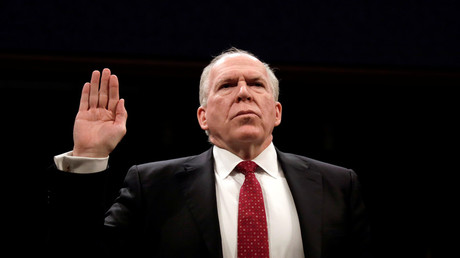
John Brennan, the former CIA director and perjurer who's now an MSNBC contributor, apparently found a point on which he and his conservative critics can agree: Both sides are ashamed that he's a white male.
Responding to an MSNBC discussion Monday about Republican claims regarding the January 6 Capitol riot, Brennan said, “I'm increasingly embarrassed to be a white male these days, in light of what I see of my other white males saying.”
The comment triggered a delighted laugh by host Nicole Wallace, who set Brennan up by opining that Republicans don't care about the lives of police officers.
“It just shows that with very few exceptions – like Mitt Romney, Liz Cheney, Adam Kinzinger – there are so few Republicans in Congress who value truth, honesty and integrity,” Brennan said. “And so they'll continue to gaslight the country the way that Donald Trump did.”
Making matters worse, Brennan added, “the fact that this has such security and safety implications for the American public and for the members of Congress… it is just a disgusting display of craven politics that really should have no place in the United States in 2021.”
Brennan's comments about honesty, gaslighting and craven politics might ring ironic, in light of his documented history of lying to Congress. He lied to a House committee about the Steele dossier and its use in the Russiagate conspiracy against former President Trump. And he lied about the CIA's spying on Senate Intelligence Committee members.
I agree.
As a white male, I'm embarrassed that John Brennan is one as well.
But it was Brennan's racial self-hatred that provided comic relief Monday on social media. “I'm ashamed he is a white male, too,” many commenters said on Twitter.
Former CIA Director John Brennan told MSNBC on Monday that he is ashamed of being a white male because of what other white males have stated recently.
And white males are ashamed of you also, John. AHH, something we can agree on!
Another observer tweeted, “Very strange comment. Most people would be ashamed of lying to Congress, not the way they were born.”
Things John Brennan shouldn't be ashamed of:
🚫His skin color
Things John Brennan should be ashamed of:
✅Arming terrorist groups
✅Lying America into forever wars
✅Serving as Obama's drone-master https://t.co/YjFUPrTG7L
— Young Americans for Liberty (@YALiberty) March 1, 2021
Still another critic called Brennan out for racism. “Let me see if I have this correct: You shouldn't have a negative opinion of a group of people (especially a different race). If you do, then you are a bigot. But this progressive is ashamed to be white because of the actions of some random white people. Sounds like bigotry.”
Let me see if I have this correct: you shouldn't have a negative opinion of a group of people (especially a different race) if you do, then you are a bigot.
But this progressive is ashamed to be white, because of the actions of some random white people.
Israel has unveiled a coronavirus tracking bracelet as an alternative for a two-week quarantine for incoming travelers, sparking privacy concerns as a top court moved to curb the Shin Bet spy agency’s role in contact tracing.
A pilot program for the tracking bracelet kicked off at the Ben Gurion airport on Monday, where 100 devices were doled out to arriving travelers as a way to avoid a stay at a military-administered quarantine hotel. Instead, those opting for the bracelet system – which features the electronic wristband, a smartphone app and a wall-mounted tracking device – will be free to return home to wait out the two-week isolation period.
While the device will alert authorities if participants venture too far from the wall-mounted tracker, Ordan Trabelsi, the CEO of SuperCom, the company behind the bracelet, said it does not collect any other information, insisting the tech is minimally intrusive.
“Nobody is forced to do it, but for those who are interested, it gives them another option: more flexibility,” he said.
We call it a ‘freedom bracelet’ because we are not locking anybody up, but rather giving them the opportunity to go home.
The pilot project – which Trabelsi has already called to expand to “thousands of units” for “wide-scale use” – may trigger further anxiety given SuperCom’s past work with a number of governments around the world to provide “offender monitoring” services, using its tracking tech to surveil prisoners and detainees. The firm signed a contract last year with a government agency in Wisconsin to offer the same service, and also sells technology used for electronic IDs, voter biometrics and cybersecurity.
As the roll-out for the tracking bracelets got underway on Monday, Israel’s top court ruled that the country’s domestic spying agency, the Shin Bet, must rein in its Covid-19 contact tracing efforts, calling the surveillance “draconian” and a threat to Israeli democracy. While the government has employed the Shin Bet for tracing since last March, the court has repeatedly challenged the practice, finally ruling that the agency may only be used under special circumstances beginning on March 14.
“From [that] day on, the use of the Shin Bet will be limited to cases in which a confirmed coronavirus patient was not cooperating in his (epidemiological) investigation, whether intentionally or not, or gave no report of his encounters,” the court said.
Israeli authorities have already unveiled a ‘vaccine passport’ system, allowing those who’ve received inoculations to access certain public spaces still closed to the unvaccinated. Similar ideas have already taken hold elsewhere, with the European Commission set to hear proposals for EU-wide vaccine passes in the coming days. Meanwhile, a number of countries, such as South Korea and Thailand, have launched tracking programs using apps and bracelets reminiscent of the new initiative in Israel.
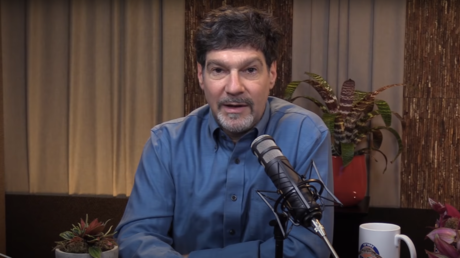
Evolutionary biologist Bret Weinstein had to relive his Evergreen College moment whe he was attacked from all sides in a Clubhouse room hijacked by hostile “anti-racist” mob aghast at the idea of white people discussing “wokeism.”
The room, dubbed “Is Clubhouse Obsessed with ‘Wokeism’?” was created by independent journalist Michael Tracey, who said he thought the Clubhouse chats “almost inevitably evolve into a discussion of 'woke-ism'... but there's seldom anyone in the room who identifies enough with the ideology to give a defense of it.”
His attempt to create a safe space for a civil discourse and let both 'woke' and 'anti-woke' understand each other better was successful at first, with Tracey tweeting that it expanded into a “large multi-racial discussion.” Little did he know that the title of the room was more like a foreshadowing of things to come.
It's international too which is doubly interesting: US, Egypt, UK, Jamaica, Sweden
Helping Tracey moderate the discussion was a black man called George, who appeared to be doing a decent job at maintaining an orderly list of speakers while trying to enable both sides “push back” against each other’s arguments. However, George left at some point while the queue of the wannabe speakers grew increasingly longer and frustrated they couldn’t vent their grievances – especially those on the “woke” side. A black woman called “Brooklyn” somehow ended up being a moderator – which, thanks to the Clubhouse rules, enabled her to boot Tracey from his own chatroom and mute him.
A five-hour-long recording of the discussion, which took place on February 26, resurfaced on social media on Monday – and some time after the two-hour mark it descends into pure mayhem.
Less than ten minutes into George being gone and the conversation has already shifted perceptibly in tone. People are upset because The List he established isn't being followed. @mtracey is clearly in way over his head. But he wanted to see Woke and is going to. 🤷♂️
— Philosopher-Prince-Prophet Coinaday 🧐 (@coinaday1) February 28, 2021
The self-appointed leader of the discussion pronounced that the white peopleBS was over, sending “all the Caucasians to the back” of the line and scolding the “f****g delusional” white participants for making use of the term 'woke' and its variations.
“Don’t use the word ‘wokeism,’ don’t use ‘woke,’ don’t use any of our dialect, it’s not for you,” she declared, adding that she didn’t “even understand why you let that white man in here with that b******t.”
Several others loudly cheered 'Brooklyn' and a string of pretty one-sided BLM-themed tirades followed for nearly an hour – before the new moderator decided to bring in the attending professor Bret Weinstein in for a kill.
— Dr. Benjamin Braddock (@GraduatedBen) March 1, 2021
Weinstein was on the defensive as soon as he took the stage, having to explain his work in evolutionary biology as one of the women controlling the discussion repeatedly insisted that the discipline was the “same thing” as eugenics.
— Dr. Benjamin Braddock (@GraduatedBen) March 1, 2021
'Brooklyn' and others would barely let Weinstein get a word in edgewise, deliberately misinterpreting the few utterances he was able to make. His declaration that he was 100 percent anti-racist, for example, was deliberately flipped to 100 percent anti-black, and his inability to answer multiple questions at once made his inquisitors impatient.
“Give us the answers now and quickly or you’re gonna get off the stage,” the woman snarled, later urging her companions to “stop letting this man wiggle out of answering the questions.” He was also accused of being an investor in the Clubhouse platform, which currently operates on an invite-only basis in a series of Zoom-like ‘rooms’ but with audio only.
He attempted to explain that his aims in studying evolutionary biology were to “recognize [racism and genocide] emerge out of evolution… what we can do about it” and denying the discipline was a “means to spread scientific transphobia” – only to have his words turned against him in a rather bizarre fashion.
“You’re a scientist and you use anecdotal experience to justify your view on pronouns,” another man on the chat said accusingly. “Just because someone has only ever eaten hotdogs doesn’t mean hamburgers don’t exist, and if hamburgers can see your statements, then why are you making them?”
Weinstein did make an attempt to dodge the allegations of “whiteness” that dominated the proceedings – clearly sensing that being of a Caucasian disposition in such a climate was borderline criminal. He protested that he was Jewish, claiming it’s “a different thing” and reminding that the Jews have too been persecuted – only for one of his interlocutors to correct him.
“You’re spicy white,” she said.
Weinstein was finally chased off stage as he attempted to turn the trainwreck into a civilized debate. “We can have a disagreement—” he began, only for several of the others to start talking over him.
“You’re going to have to go to the audience and you need to cash out everybody up here $1,000 before you coming back up,” 'Brooklyn' smugly declared. Another man insisted that after the group had done Weinstein the favor of “letting him” speak, he had merely proven himself a “white supremist [sic]” by “spewing” white supremacist talking points. He did not say what those talking points were. The professor was then apparently forcibly muted by the moderators.
Weinstein was famously run out of Evergreen College by a mob of angry students in 2017, after questioning the need for a 'Day of Absence' in which white students would be banned from campus – the flip-side of a longstanding protest by black students in which they stayed home to call attention to their significance on campus.
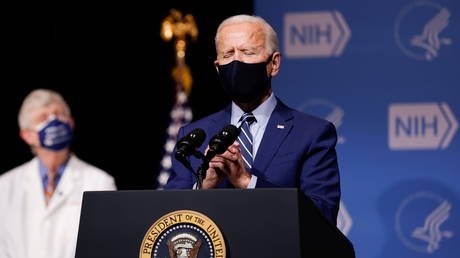
President Joe Biden will push ahead on making amends for America's “systemic racism,” creating more opportunities for black people right away rather than waiting for a reparations study, a White House adviser said.
“We don't want to wait on a study,” Cedric Richmond, director of the White House Office of Public Engagement, said in an ‘Axios on HBO’ interview. “We're going to start acting now.”
White House press secretary Jen Psaki confirmed on February 17 that Biden supports legislation in the Democrat-controlled Congress to fund a study of paying reparations for slavery and discrimination dating from 1619 to present. While critics, such as former presidential candidate Marianne Williamson, suggested that a study is a way of stalling, Richmond said the Biden administration is ready to take action.
I agree with her. But we need more than a bill “to study the lasting affects of racism and slavery;” we know what they are. It’s time to get to the negotiating table and start making it happen. #Reparationshttps://t.co/YjI3GGSpHs
“We have to start breaking down systemic racism and barriers that have held people of color back and especially African Americans,” he said. “We have to do stuff now.”
For instance, Richmond said that providing free tuition at historically black colleges and universities and free community college tuition to black people would put the government “well on your way” to redressing slavery and discrimination. An executive order signed by Biden in January calls for full implementation of the Fair Housing Act, which Richmond said will help break down barriers in housing and wealth-building.
The Biden administration has rejected the idea of sharing Covid-19 vaccines with the hard-hit neighbor Mexico, White House press-secretary Jen Psaki said, adding that it can only be discussed after all Americans get their shots.
"The administration's focus is on ensuring that every American is vaccinated. And once we accomplish that objective we're happy to discuss further steps," Psaki said when asked about possible vaccine sharing during a briefing on Monday.
The comments came hours before the virtual meeting between US President Joe Biden and his Mexican counterpart, Andres Manuel Lopez Obrador.
The Mexican president had reportedly asked Biden for help with the jabs in January, and was expected to return to the issue during the negotiations.
“We'd like to get an answer on a request that we've already made ... about the vaccines” from Biden, Lopez Obrador said during a press conference on Monday. “Provided he's of the view the matter should be addressed. We must be respectful.”
With 186,000 fatalities so far, Mexico is the third in the world in the number coronavirus-related deaths after the US (513,000) and Brazil (255,000).
In this dire situation, Lopez Obrador has become one of the harshest critics of how vaccines are being distributed internationally. He said that it was “totally unfair” that rich countries were “hoarding” the jab for themselves and urged the UN to interfere so that poorer nations could gain access to the immunization too.
Mexico has currently given the first shot to just over 1.8 million people, or 1.4 percent of its population. The country’s vaccination campaign has gotten off to a slow start, largely due to the delays in shipments by the US pharma giant Pfizer.
In order to compensate for the shortages, the government has turned to Russia’s Sputnik V and Chinese Sinovac vaccines. Mexico City and Moscow have agreed the supply of 24 million doses of the Russian immunization, with the first shipment arriving in the country in late February and being swiftly put to use.
Think your friends would be interested? Share this story!
As Johnson & Johnson rolls out its freshly approved Covid-19 vaccine in the US, it faces a religious controversy as the Catholic Archdiocese of New Orleans has labeled it “morally compromised” over links to abortion cells.
Catholics are advised not to receive the vaccine because Johnson & Johnson used cell lines from abortions in both testing and production of the new product, the Archdiocese said in a statement.
Pfizer-BioNTech and Moderna have utilized cell lines from abortions in testing their previously approved vaccines, but not in their manufacturing processes, so they are considered “morally acceptable” because of their “extremely remote” connection to abortion, argued the second-oldest Catholic province in the US.
“We maintain that the decision to receive the Covid-19 vaccine remains one of individual conscience, in consultation with one's healthcare provider,” the Archdiocese added. “We also maintain that in no way does the church's position diminish the wrongdoing of those who decided to use cell lines from abortions to make vaccines. In doing so, we advise that if the Moderna or Pfizer vaccine is available, Catholics should choose to receive either of those vaccines rather than the new Johnson & Johnson vaccine because of its extensive use of abortion-derived cell lines.”
The Roman Catholic Church has been supportive of Covid-19 vaccines in general. In fact, Pope Francis asserted in January that people have a “moral obligation” to receive one of the new inoculations as soon as possible.
“It is the moral choice because it is about your life but also the lives of others,” he said.
However, the church also remains staunchly opposed to abortion and any exploitation of tissue from aborted babies. The cells at issue with the new coronavirus vaccines trace back to fetal tissue from abortions performed in the 1970s and 1980s. Those cells have been replicated billions of times and manipulated in pharmaceutical research, similar to the treatment of cervical cancer cells of a woman named Henrietta Lacks, a patient at Johns Hopkins Hospital in Baltimore.
Lacks’ cancer cells had an extraordinary ability to double every 20-24 hours, rather than quickly die like other cancer cells, allowing them to be used to study the effects of radiation, poisons, drugs, hormones and viruses on the growth of cancer cells without experimenting on humans. Though Lacks herself died in 1951, her cell lines live on today.
Johnson & Johnson aims to ship out 100 million doses of its new vaccine by the end of June, including 3.9 million that are scheduled to go out this week, after receiving emergency use authorization from the FDA on Saturday. Unlike the Pfizer-BioNTech and Moderna vaccines, it requires only one dose for a person to be inoculated.
Like Russia's Sputnik V vaccine, the Johnson & Johnson product is a human adenovirus vector-based vaccine, which can’t replicate in human cells but triggers them to make “spike” proteins. The immune system recognizes those proteins as foreign and makes antibodies against them, which protect against the targeted virus. The Pfizer-BioNTech and Moderna vaccines use so-called messenger RNA (mRNA) to trick the person's cells into making the proteins.
The Johnson & Johnson jab was shown in US testing to be 72 percent effective at preventing against Covid-19 infection and 86 percent effective at preventing severe illness or death. The two-dose Sputnik V tested at more than 95-percent effective, just above the Pfizer-BioNTech and Moderna vaccines. Adenoviral vaccines – including the Johnson & Johnson's, Sputnik V and the AstraZeneca-Oxford vaccine in Europe – can be stored in refrigerators, whereas the mRNA doses have to be kept deeply frozen.
Washington is so eager to help Ukraine counter what it calls “Russian aggression,” it is sending Kiev patrol boats the US Navy wants to phase out, and holding another $150 million back pending “defense reforms.”
The Pentagon announced on Monday that the US will send $125 million worth of “lethal aid” to Kiev as part of the Ukraine Security Assistance Initiative (USAI), including “training, equipment, and advisory efforts to help Ukraine’s forces preserve the country’s territorial integrity, secure its borders, and improve interoperability with NATO.”
Pentagon spokesman John Kirby specifically highlighted the addition of two more Mark VI patrol boats to “enhance Ukraine’s capacity to patrol and defend its territorial waters,” bringing the total delivered in 2021 to eight.
BREAKING: @PentagonPresSec announces a new $125M package for Ukraine security, including training, equipment and advisory efforts to help Ukraine secure its borders, defend against Russian, and improve interoperability with NATO.
The US is also sending “additional counter-artillery radars and tactical equipment” and “equipment to support military medical treatment and combat evacuation procedures,” while continuing to provide Ukraine with “support for a satellite imagery and analysis capability,” the Pentagon said.
"This package does not include Javelin missiles,” Kirby told reporters on Monday, referring to anti-tank weapons first delivered to Ukraine in June 2020.
However, Washington is holding off on the remaining $150 million approved by Congress until the Pentagon and the State Department certify “sufficient progress” has been made on reforms such as modernization of Ukraine’s military “in line with NATO principles and standards” and adopting higher standards of civilian control and procurement transparency.
The contract for the two additional boats was already awarded to the manufacturer in January. It’s worth just under $20 million and is scheduled to run through December 2022. Aid to Ukraine appears to be the only purpose for the Mark VI boats now, as the US Navy apparently doesn’t intend to buy any more of them.
The US Navy had originally planned for a total of 48 patrol boats, but ended up with only 12, with the last purchase made in 2017. It now reportedly wishes to get rid of them altogether by the end of 2021. Wargaming scenarios against adversaries such as China and Russia showed the Mark VI boats were “not really needed” given their small size and firepower, Naval News reported in January, citing Marine Corps Major General Tracy King, head of the Navy’s expeditionary warfare division.
King added that the boats were “very expensive to maintain.”
While the final decision will be made by Congress and the Biden administration, the Navy isn’t rushing to buy any more Mark VIs, and the US seems happy to send them to Ukraine instead. The boats are presumably intended to replace the three vessels impounded by Russian coast guard in November 2018, during the Kerch Strait incident.
The three Ukrainian boats tried to force their way through the straits between the Russian mainland and Crimea, instead of following the procedures and notifying of its route in advance. The peninsula had overwhelmingly voted to rejoin the Russian Federation in March 2014, following a US-backed violent coup in Kiev.
The US refuses to recognize Crimea as part of Russia and has echoed Kiev’s accusations of “Russian aggression” to send weapons, instructors and equipment to Ukraine ever since.
Washington has announced a set of measures against dozens of Saudi officials following a report on murder of journalist Jamal Khashoggi, but said that maintaining good relations with Riyadh is “important to US interests."
A total of 76 Saudi officials involved in what was described as “acts of repression” against various dissidents, including the 2018 killing of Khashoggi, have been banned from entering the US, State Department Spokesman Ned Price said on Monday as he announced the new strategy to “recalibrate” relations between Washington and Riyadh.
The measures also involved adding another former senior Saudi intelligence official to the US list of human rights violators under the Global Magnitsky Act. The Rapid Intervention Force – a unit of the Saudi Royal Guard supposedly engaged in the “counter-dissident operations,” according to Price – got on the list as well while Washington urged Riyadh to “disband the group” and abandon its anti-dissident practices.
The US fell short of sanctioning Saudi Crown Prince Mohammed bin Salman, even though an intelligence community report released on Friday accused the royal of approving the capture and killing of Khashoggi inside the Saudi consulate in Istanbul.
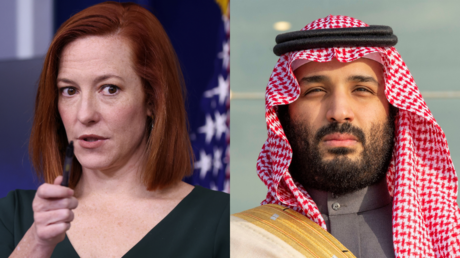
White House Press Secretary Jen Psaki said on Sunday that Washington would not resort to sanctions but opt for “more effective” measures instead. Yet, it seems that the measures announced on Monday were mostly focused on actively calling Riyadh to change its ways and respect “American values.”
“We seek a partnership that reflects our important work together, and our shared interests and priorities, but also one conducted with greater transparency responsibilities and in accord with the American values,” Price said.
The State Department spokesman repeatedly said that Washington sees “value in sustaining partnership” and would like to see the relations that “already span 80 years” to go forward.
“Our relationship with Saudi Arabia remains important. It is important to US interests and requires continued progress and reforms to ensure that this partnership rests on strong fundamentals and continues to advance our shared objectives in the Middle East,” Price said, as he named “forging ties across the region,” avoiding a war with Iran and “forging a historic peace agreement” between Riyadh and Tel Aviv among them.
The administration of President Joe Biden announced an end of US support to any offensive operations in Yemen, including through arms sales, and immediately halted two arms deals with the Saudis.
Price also said that Washington remains strongly “committed” to the Saudis’ national security and helped them “defend themselves” against UAVs and missiles launched by the Yemeni Houthi militants.
The United States joins the international community in announcing additional humanitarian assistance to the Yemeni people. We will continue our leadership in responding to and finding the political solution for the crisis in Yemen. #YemenCantWaithttps://t.co/PIrKWwvhGY
While the US has condemned the killing of Khashoggi, it has avoided punishing Riyadh too harshly for it. In 2019, US President Donald Trump vetoed three bills from Congress that would have prohibited arms sales to the desert kingdom, despite pressure from both the Republicans and the Democrats.
Biden promised some tough action against the Saudi crown prince during his presidential campaign. He appears in no rush to follow through on those promises now that he is in office. Psaki said on Sunday that placing restrictions on “leaders of foreign governments” has simply not been the US way historically, though the presidents of Belarus, Venezuela and Iran may disagree.
Think your friends would be interested? Share this story!