EU member states will be allowed to use only official EU-approved Covid-19 vaccines, Brussels said in response to remarks by Hungarian Prime Minister Viktor Orban that Budapest was negotiating for shots with Russia and China.
“There is no question that any vaccine that is, or could be, made available on the territory of the European Union would have to comply both with the quality standards that are expected for these types of products in the EU and follow the approval procedures” currently in effect, European Commission spokesman Eric Mamer said at a press conference on Friday, asked about Orban’s comments.
While not calling out Orban by name, Mamer’s comments came after Hungarian PM said Budapest was talking to Beijing and Moscow and hoping to have two or three different vaccines by early next year.
The first shipment of vaccines should arrive in December or January, and Hungary will be able to “declare victory over the pandemic” by next spring, Orban said on Friday in a radio interview.
It appears that Brussels will not allow Hungary to do so, however, as the bloc has signed agreements with AstraZeneca, Sanofi-GSK, and Johnson and Johnson for “safe and effective vaccines” against the coronavirus, once they complete the clinical trials.
“We are not in negotiations with either Russian or Chinese companies,” Mamer added. “That is the European vaccine strategy. All member states have signed up to this process.”
Johnson & Johnson had paused its trials in mid-October, citing an “unexplained illness” in one of the participants. AstraZeneca had also halted their trials over a UK volunteer experiencing complications, but restarted them even after a Brazilian volunteer died on October 20.
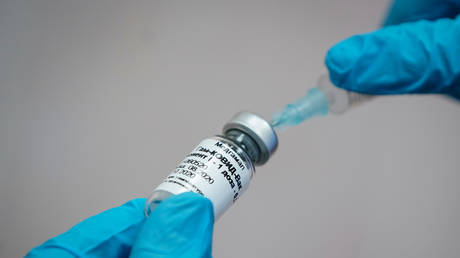
Russia was the first in the world to register a coronavirus vaccine. Dubbed ‘Sputnik V’, it is based on the adenoviral vector platform previously studied and considered safe, and is currently undergoing phase-three trials. Moscow has applied for the World Health Organization’s (WHO) Emergency Use Listing program, which would allow accelerated approval of the vaccine for use.
Brussels and Washington have objected to the Russian vaccine, ostensibly on the grounds of safety. The US also appears to have leaned on governments to pressure them away from ‘Sputnik V’. On October 16, the US embassy in Kiev announced that Ukraine “will NOT be buying Russia’s [Covid-19] vaccine, which has not passed clinical trials for safety!”
Meanwhile, Philippines President Rodrigo Duterte has expressed distrust of Western pharmaceutical companies, accusing them of being “all about profit.” Duterte said he would seek a deal to buy the vaccine from China or Russia, which Manila was prepared to pay for.
Some 2,000 doses of the Russian vaccine were sent to Venezuela in early October, after the authorities in Caracas asked for help due to US and EU sanctions ravaging the country’s healthcare system.
The virus, which was first detected in China in December 2019, quickly spread around the world, with the WHO declaring a pandemic in March. Almost 45.5 million people have been infected so far, with 1.18 million deaths attributed to the virus. Much of Europe and the US have locked down in an effort to slow the spread, with disastrous economic consequences.
The EU’s Mamer did acknowledge that “at some point” vaccines produced outside the bloc “may” be considered for distribution, but declined to elaborate.
A complete separation of the US and Chinese economies is utterly unrealistic, a senior Chinese official has said, emphasizing the need for cooperation between various nations amid the pandemic-induced global economic uncertainty.
Speaking at a news briefing in Beijing on Friday, the deputy director of the Office of China’s Central Commission for Financial and Economic Affairs, Han Wenxiu, argued against severing ties between the world’s two largest economies.
“Decoupling is basically not realistic, and there’s no benefit for China or the US, or the entire world,” Han stated.
Those who want decoupling are few. Those who want collaboration are far more.
The official explained that the US and China will be able to maintain their positions as the largest economies only if they complement each other. Moreover, the two should be operating in an open global environment, as it provides more opportunities for the rest of the world, Han added.
While the US and China remain major business partners, the duo have been locked in an open economic standoff for over two years already. US President Donald Trump has repeatedly threatened a “complete decoupling” of the American economy from China, accusing Beijing of using unfair trade practices. While the president insisted it was not only possible, but even beneficial for the American economy, other top US officials have doubted his idea was even remotely realistic.
The US-China economic standoff, which has already escalated into a full-blown trade war, is further reinforced by various geopolitical tensions. The most recent flashpoint came last week, after the US approved a $1.8 billion arms sales to Taiwan, which Beijing considers to be an integral part of China. China demanded Washington abandon its arms sales plan and immediately “stop military contact” with Taiwan, threatening sanctions against the American arms manufacturing giants if the deal goes through.
Think your friends would be interested? Share this story!
Now three quarters of a century old, the Russian nuclear industry in 2020 has influence way beyond its borders.
Russia is сontributing to the ITER (International Experimental Thermonuclear Reactor) mega-science project that aims to prove fusion is a feasible clean energy source. ITER Director-General, Bernard Bigot, told us that, “Without innovation, we cannot rely on existing resources.”
“Humanity has been relying on renewable energy for centuries, a millennium indeed, but it was before we were less than one billion inhabitants.”
Given the planet's surging population, Bigot believes we need renewable energy, but complimented by mass production. He sees hydrogen fusion as the way forward, due to a near unlimited supply.
“The raw material is water and lithium, and there’s enough water and lithium on Earth to supply energy for a population of 10 billion inhabitants for a hundred million years.”
Bigot added that the low-levels of helium released and general safety, means this sort of fusion has little to no impact on the environment and climate.
India has tested yet another missile, as it ramps up its military trials program amid ongoing tensions with China. The anti-ship projectile left the target vessel severely damaged and in flames.
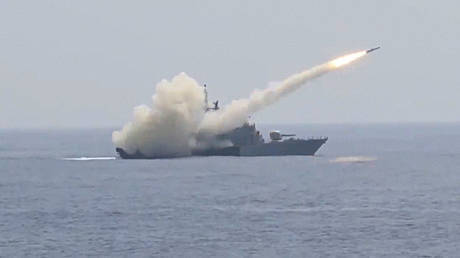
On Friday, a KH-35 Uran missile was test-fired from the INS Kora, smashing into the decommissioned minesweeper INS Cannanore in the Bay of Bengal.
According to the Indian Navy, the test was carried out at “maximum range” and the projectile demonstrated “precise accuracy,” leaving the target ship in flames. The navy has shared the photos of the live-fire exercise and the damaged ship on social media, highlighting India’s combat readiness on the high seas.
Videos showing the test-firing have also emerged on Twitter.
BREAKING NOW.
WATCH THE FULL VIDEO 👇
Kh-35 Uran, an antiship missile fired by Indian Navy's Guided Missile Corvette INS Kora.
It hit the target ship M68 at maximum range with precise accuracy in Bay of Bengal. Target ship severely damaged & in flames. 👇@NewsX & @Inkhabarpic.twitter.com/9Dimmqqfk5
Originally of Soviet design, the KH-35 has been adopted by the Indian armed forces since 1996. The missile was fired from a guided-missile corvette – one of five currently active in the Indian navy.
This was the second publicly announced test-firing of a KH-35 this month. Last Friday, the navy launched Uran from INS Prabal into a decommissioned Godavari-class frigate in the Arabian Sea.
In the past two months, India has carried out more than 10 missile tests, including of the Nirbhay cruise missile, the supersonic surface-to-surface Shaurya strategic missile, and a laser-guided anti-tank guided missile.
India has been stepping up its military trials, primarily of indigenous-built hardware, as part of an attempt to demonstrate its capabilities amid heightened tensions with China along the Line of Actual Control – a de facto border in the Himalayas, as well as in the Indian Ocean. Earlier this year, troops from the two nations clashed in Eastern Ladakh, causing casualties on both sides, although Beijing has not officially commented on the numbers.
India and China are currently engaged in ongoing military- and diplomatic-level dialogue in the hope of arriving at a “mutually acceptable solution.”
The Tunisian suspect in the attack that left three people dead in the French southern city of Nice on Thursday was arrested for violence and using a knife back in 2016, a Tunisian judiciary official has said.
The Nice attack suspect, identified as a 21-year-old migrant from Tunisia who arrived in France a few weeks ago, was known to authorities in his home country. Back in 2016, he was arrested for knife violence, Mohsen Dali, a Tunisian judiciary official, said on Friday.
In the aftermath of the deadly attack, Tunisia launched its own investigation into the incident. Late on Thursday, officials said the suspect was not on its list of suspected militants at the time that he left the country in mid-September.
Tunisia promised to investigate the claims made by an entity called the Mahdi Organisation which it said on social media that it was responsible for the attack. Authorities have already launched a probe to determine whether the group exists and if what it says is true.
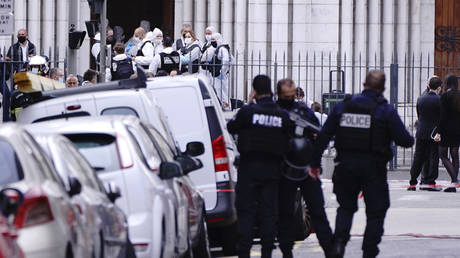
The deadly assault unfolded early on Thursday, when the suspect attacked people with a knife inside the largest Catholic church in the city. He managed to slit the throats of two people, who died at the scene, and to mortally wound a third, who managed to escape the church, but died at a restaurant nearby.
The attacker was shot and critically injured by the four police officers who responded to the incident, and currently remains in hospital in a serious condition.
Think your friends would be interested? Share this story!
A driver has plowed a car into the gates of the iconic Grand Mosque in the holy city of Mecca, damaging the entrance to the shrine. Nobody was seriously injured in the incident and the motorist is now in custody.
The collision on Friday night saw a driver careen off the road and slam into the mosque – known formally as the Masjid al-Haram – captured in footage circulating online.
A driver rammed his car into Door 89 of the Grand Mosque in Mecca (Masjid al-Haram) at 22:25pm Saudi time.
The driver was arrested and based on video footage posted on social media, local media reports, there were no casualties. pic.twitter.com/CzNKWq5OO5
According to a representative for the Mecca regional government, Sultan al-Dosari, the car “swerved while moving at a high speed on one of the roads surrounding the southern courtyard of the Grand Mosque” before crashing. “Thankfully, no one was injured,” he added, sharing a photo of the wreck.
The arrested citizen is in an abnormal condition. He was referred to the public prosecution.
Saudi authorities say they arrested the driver of a car that sped into the pedestrian area (it appeared empty at the time) outside Masjid Al Haram in Mecca, before crashing into the mosque. He's described as a Saudi citizen who was "in abnormal condition." No injuries reported. https://t.co/fKcUClcMwi
Makkah Government: “The security authorities responded to an accident that involved a car hitting one of the doors of the Grand Mosque as a result of drifting while traveling at high speed on one of the roads surrounding the southern square of the Grand Mosque 1/2 pic.twitter.com/Nk14KnapLc
The renowned house of worship resumed public prayer earlier this month following a lengthy hiatus amid the coronavirus pandemic, closing its doors for some seven months. Saudi authorities also permitted citizens to gradually return to performing the Umrah pilgrimage in October, which typically attracts millions of worshipers from around the world to Mecca and Medina, the two holiest cities known to Islam. With the health crisis, however, the number of devotees allowed to visit will be limited to 6,000 per day.
Think your friends would be interested? Share this story!
British Prime Minister Boris Johnson will reportedly impose a national lockdown next week after his scientific advisers warned that the NHS could be overwhelmed by mid-December and more than 85,000 people could die this winter.
The dramatic move is expected to be announced sometime next week, The Times newspaper and the Daily Mail reported on Friday night, citing sources from within 10 Downing Street. The details or the duration of the supposed lockdown are yet unknown.
Both the Mail & the Times have been briefed there is likely to be a national lockdown from next week pic.twitter.com/pb56MsgXNg
Johnson is reportedly meeting over the weekend with the leaders of Northern Ireland, Scotland and Wales to work out “a common approach to Christmas,” as his cabinet is divided on the new lockdown. Health and Social Care Secretary Matt Hancock and Cabinet Office Minister Michael Gove supposedly back the measure, while Chancellor Rishi Sunak has reservations.
A recent study by the University of Warwick blamed Sunak’s ‘Eat Out To Help Out’ initiative for the spike in cases that contributed to the ‘second wave’ of the virus.
The disturbing reports come after the SAGE committee presented 10 Downing Street with a bleak assessment that the coronavirus is spreading “significantly” faster than their original “worst-case scenario” predictions, and if it continues on its current track would kill more than 85,000 this winter.
More than 46,000 deaths have been attributed to the coronavirus so far, out of some 992,000 infections in the UK since the start of the pandemic. The Mail reported that 50,000 Britons were getting infected every day, citing the Office of National Statistics. However, on Thursday the UK registered 23,065 new infections and 280 new deaths.
The scientists, led by Chief Medical Officer Professor Chris Whitty and Chief Scientific Adviser Sir Patrick Vallance, have warned Johnson that all hospitals in England will be full by December 17.
As of Friday morning, Foreign Secretary Dominic Raab was still defending the current tiered strategy, saying that a national lockdown would be regarded as “desperately unfair” in less affected areas.
Lockdown critics have denounced the notion of a “circuit-breaker” lockdown, saying that previous such measures did little to nothing to stop the virus.
“The concept of a four-week lockdown to save Christmas is yet more cruel and inhumane policy which will further fuel the growing mental health crisis – all justified by holding out a false hope,” said Jon Dobinson, of the group Recovery. “People are dying in their thousands from lockdown and restrictions: it's time to focus on that.”
Experts advising Johnson believe the UK is on track to face 1,000 deaths a day within a month if nothing changes, however. The government had previously been told to prepare for 85,000 deaths this winter, with 500 deaths a day and more than 300,000 people hospitalized, but SAGE said things have already accelerated past this “reasonable worst-case scenario.”
Germany’s deputy finance minister said on Friday that the European Union will need pragmatism in its relations with the UK because the City of London remains Europe’s biggest financial center.
German companies “rely massively” on wholesale financing offered from the City of London, Joerg Kukies told an Afore Consulting online event. “So in that sense we will have to maintain pragmatism, no matter what happens,” the deputy finance minister explained.
Kukies said he was “deeply concerned” about the lack of progress in trade talks between Brussels and London. However, he expressed hope that the current situation will not lead to “animosity,” citing the intensity of relationships between EU member states and Britain.
The UK’s post-Brexit transition period ends on December 31, and the City could be largely cut off from the bloc after that.
Brussels is negotiating UK financial firms’ access to the EU separately from trade deal talks. European Commission President Ursula von der Leyen says these talks are “making good progress,” a view that contradicts that of Kukies.
The trade and security discussions are now being held in Brussels, after a week in the UK capital, and critical issues are still common rules and standards for firms, as well as rules governing state subsidies and the fisheries, according to von der Leyen.
The row over fishing quotas has persisted as a major stumbling block, with Paris insisting the EU should not bow to UK demands. French Europe Minister Clement Beaune went further by saying, “the face of Brexit will be the face of our fishermen,” and adding that their interests should be protected.
Despite the current disagreements, however, Brussels hopes to start the ratification process in mid-November, according to European Council President Charles Michel.
The head of the DHS has castigated Twitter CEO Jack Dorsey in a withering letter, arguing his platform endangered national security after locking the account of a top border official over a post it alleged to “promote violence.”
The Department of Homeland Security acting chief Chad Wolf penned the letter to Dorsey on Friday, insisting “corporate bureaucrats” should not act as arbiters of truth for the American public, calling Twitter’s move to suspend the handle of Customs and Border Patrol (CBP) executive Mark Morgan “unjustified” and “disturbing.”
“The fact that the tweet was removed and the account locked is startling,” Wolf said. “It is hard to understand how anyone believed Mr. Morgan’s tweet promoted violence, threats or harassment. Especially considering the facts about the border wall system support the tweet.”
There was no reason to remove Mr. Morgan’s tweet from your platform, other than ideological disagreement with the speaker. Such censorship is disturbing. Twitter’s conduct censoring US government officials also endangers the national security.
Twitter’s censoring of factual information poses a threat to national security.
In the offending post – which has since been reinstated – Morgan said the CBP was continuing to work with the Army Corps of Engineers to construct a wall along the border with Mexico, adding that “every mile” of the barrier “helps us stop gang members, murderers, sexual predators, and drugs from entering our country. It’s a fact, walls work.”
.@CBP & @USACEHQ continue to build new wall every day. Every mile helps us stop gang members, murderers, sexual predators, and drugs from entering our country.
Wolf insisted Morgan’s tweet did not promote violence of any sort and was factually accurate, arguing that the CBP “arrests thousands of violent criminal gang members each year,” rescues young women forced into the sex trade and “intercepts dangerous drugs,” including “enough of the opioid fentanyl to kill every man, woman and child in the United States several times over.”
He also accused the platform of lying about events surrounding Morgan’s lock-out, noting that a Twitter spokesperson gave a misleading quote to the media about how the company revived the account.
“Adding insult to injury – and insult to Americans’ intelligence – Twitter spread disinformation by misrepresenting Twitter’s intentional censorship,” Wolf went on, adding that a company representative told Politico’s Caitlin Oprysko that it reversed the decision on appeal. Wolf said that gave “the false impression that Twitter’s appeal process remedied a mistake, but in fact Twitter’s appeal process failed.”
Twitter actually denied CBP’s appeal. Twitter only reversed itself after controversy and embarrassment escalated.
After being locked out of his handle for some 20 hours, Morgan has since issued a statement about the incident, saying Twitter is “out of control in their clear bias against this administration” and slamming the company for “censorship” that should “outrage every American.”
Back online after Twitter lock out for ~20 hours. @Twitter’s censorship should outrage every American. Not only did Twitter block me from posting, they BLOCKED YOU from the TRUTH.
An earthquake in the Aegean Sea has prompted Turkey and Greece to lay aside their rivalry over resources in the Mediterranean as the leaders of the two neighbors offered each other condolences and help in the wake of the disaster.
A powerful quake, measured at 6.6 magnitude by Turkish authorities and 7.0 by the United States Geological Survey (USGS), struck the Aegean shore early Friday morning. More than 800 people were injured and at least 22 others lost their lives in Turkey, with the port of Izmir taking the brunt of the destruction. On the Greek island of Samos, the bodies of two teenagers – a boy and a girl – were discovered near a collapsed wall after the tremors.
Following the tragedy, Greek Prime Minister Kyriakos Mitsotakis called Turkish President Recep Tayyip Erdogan to offer condolences, while the foreign ministers of the two countries also made contact, with the Greek side expressing readiness to send rescue teams to Izmir to help extract people from the rubble.
“Whatever our differences, these are times when our people need to stand together,” Mitsotakis wrote on Twitter.
Erdogan responded in kind, saying that “Turkey, too, is always ready to help Greece heal its wounds.”
That two neighbors show solidarity in difficult times is more valuable than many things in life.
Relations between Ankara and Athens have hit a low point in recent months due to competing claims to continental shelves in the east Mediterranean, which are believed to be rich in energy resources.
The dispute has seen the two neighbors – both NATO member states – mobilize warships and planes, with Greece calling on the EU to slap Turkey with sanctions over what it deemed aggressive behavior after Ankara sent a research vessel into disputed waters near Cyprus.
At least four people have died after a powerful earthquake struck off the coast of Turkey. The tremblor toppled buildings in Izmir, caused damage across several Turkish towns and shook the Greek capital of Athens.
The USGS issued a preliminary alert recording the quake as a 7.0 magnitude temblor, but Turkey's Disaster and Emergency Management Presidency (AFAD) said it was a 6.6 quake which struck along the Aegean coast.
The temblor struck shortly after 1:51pm local time near the Greek island of Samos, with the Mayor of eastern Samos claiming multiple buildings had collapsed.
Eyewitness footage from around the Aegean shows crowds evacuating onto the streets as large dust clouds emanated from collapsed buildings in the distance.
Turkey's Interior Minister Süleyman Soylu issued a Twitter statement about the earthquake, claiming that at least six buildings had collapsed in Izmir and reports of potential casualties were streaming in from several other cities.
“Until now, 6 building demolition notices have been received in İzmir Bornova and Bayraklı. Damage and loss of life reported in Uşak, Denizli, Manisa, Balikesir, Aydın and Muğla, our teams continue their screening and interventions in the field. Get well soon,” Soylu wrote.
According to local media reports, the earthquake lasted roughly 15 seconds, with shockwaves felt as far away as Istanbul and Athens.
Turkey's Disaster and Emergency Management Presidency (AFAD) said the epicentre of the use was 17 km (11 miles) off the coast of the Izmir in the Aegean Sea, at a depth of 16km. The USGS said the quake occurred at a depth of 10km some 33.5km offshore.
Fears were raised that a tsunami could hit in the aftermath of the deadly quake as eyewitness footage from the seafront in Izmir revealed that the sea had retreated several meters.
Former Green Party candidate Jill Stein has won a grueling four-year legal battle to inspect the software running Wisconsin’s voting machines and publish what her team finds – but too late to run the analysis before 2020’s vote.
The Stein 2016 Recount Campaign finally crushed an attempted gag order by machine mega-manufacturer Election Systems & Software, they announced on Friday, winning the right to inspect the source code of the machines used in Wisconsin and release her team’s conclusions about the accuracy and reliability of the software to the public.
BIG NEWS: the #Recount campaign has won our court fight in Wisconsin, overcoming the final obstacle to a groundbreaking examination of voting machine source code by defeating voting machine vendors' attempts to gag us from telling the public what we find.https://t.co/GKjsxRYrPB
While the ruling represents a decisive defeat for ES&S – one of the largest makers of the devices in the US – it came too late to conduct any inspection before next week’s presidential election, Stein lamented.
It’s outrageous that voting machine vendors that profit from government contracts have been able to use those profits to buy political influence and prevent scrutiny of their machines through legal machinations.
“This is a major win for voters everywhere,” she nevertheless said. Stein’s designated expert, University of Michigan Computer Science and Engineering professor Dr. J. Alex Halderman, also praised the opportunity for “independent scrutiny.”
The ex-candidate began her recount crusade following President Donald Trump’s November 2016 victory, demanding a recount in Wisconsin, Michigan, and Pennsylvania. Stein’s 2018 settlement with the state of Pennsylvania required it to replace paperless voting machines with alternatives that leave a paper trail by 2020, with an extra round of audits added by 2022. The suit against Wisconsin also caused the state to decertify one model of voting machine that was caught miscounting ballots during the partial recount her legal actions secured, and the recount itself revealed one in every 170 votes had been “miscounted.”
Stein had less luck in Michigan, where the recount was squelched before it was complete – though not before her revealing the state had placed dodgy machines in urban districts, leading to over 80 ballot scanner breakdowns on Election Day and snarling efforts to untangle the matter in arcane legal red tape.
Despite raising millions of dollars to have votes recounted with the stated purpose of helping “create fair elections,” Stein is loathed by many of the Democratic faithful, who blame her – along with failed Democratic presidential candidate Hillary Clinton’s rival Bernie Sanders, WikiLeaks co-founder Julian Assange, Russian President Vladimir Putin, and a hefty portion of the American electorate – for Clinton’s loss. The physician, who also ran for president on the Green ticket in 2012, opted not to run again in 2020, perhaps weary of being blamed for the failure of other candidates.
Voting machine manufacturers don’t help the generally low level of trust in their products by refusing to disclose who actually owns them, as several voting machine suppliers declined to do when asked by the North Carolina Board of Elections last year. ES&S briefly merged with competitor Diebold in 2009, creating a de facto monopoly before the federal government sued the megacorporation for antitrust violations, forcing it to spin off one company’s assets. Diebold in turn was notorious for alleged collusion with the Republican Party, returning results favorable to the GOP under dodgy circumstances in 2000, 2002 and 2004.
Most states’ voters in 2020 have the option of voting by mail if they prefer due to the coronavirus pandemic, though that method has been criticized and fraught with various problems. From “wrong” ballots, to mysteriously discarded votes, to dead people receiving ballots, it’s not much of a surprise that a recent poll found just 15 percent of Americans had faith in US democracy.