French Secretary of State for European Affairs Clement Beaune has said the country will start receiving vaccines from AstraZeneca next week. Paris had threatened the company with sanctions in a row over supply.
“We will speed up deliveries. As of the end of the week or the beginning of next week at the latest, we will have doses of AstraZeneca vaccines which will begin to arrive in France,” Beaune told radio station France Inter on Monday. “We will begin to vaccinate as planned at the end of the week with the doses of AstraZeneca.”
Beaune earlier tweeted about the vaccines from AstraZeneca: “The European pressure is paying off: nearly 10 million additional doses in the first trimester, faster deliveries.”
He was responding to a tweet by European Commission chief Ursula von der Leyen which said that AstraZeneca will deliver nine million more doses of the vaccine in the first quarter of 2021 and start deliveries “one week earlier than scheduled.” Von der Leyen also said the company will expand its manufacturing in Europe.
France threatened the British-Swedish company with possible sanctions if it prioritized its UK clients over the European ones. Germany also indicated that it would take action against vaccine-makers that fail to deliver on their European contracts.
AstraZeneca warned earlier this month that once Brussels approves its vaccine, the “initial volumes will be lower than anticipated.” This prompted backlash from the EU, which itself has received criticism from some member states over the pace of the rollout of the vaccines.
“We reject the logic of first come, first served,” said EU Health Commissioner Stella Kyriakides. “That may work at the neighborhood butcher's, but not in contracts and not in our advanced purchase agreements.”
AstraZeneca CEO Pascal Soriot denied the allegation that he was selling to the highest bidder. He argued that the plan to cut supplies was caused by production problems at the site in Belgium. “But the UK contract was signed three months before the European vaccine deal. So, with the UK, we have had an extra three months to fix all the glitches we experienced,” he told Italian media.
Think your friends would be interested? Share this story!
Just hours after revelations emerged regarding his mammoth Barcelona contract, Lionel Messi proved again why he is valued quite so highly as the Argentine ace scored a trademark free-kick to reach a new milestone for the Catalans.
Messi curled a stunning strike over a five-man wall and into the top corner to put Barcelona 1-0 ahead in the 20th minute of their La Liga clash with Athletic Bilbao on Sunday, registering his 650th goal in Barca colors.
While a Jordi Alba own-goal leveled the scores just after half-time, a winner from Antoine Griezmann in the 74th minute gave Barcelona all three points at the Nou Camp.
The result moved Ronald Koeman’s team up to second in the La Liga table, ahead of Real Madrid on goal difference but 10 points adrift of leaders Atletico Madrid – who also have a game in hand.
Much of the talk leading up to Sunday’s game had been on the staggering details of the contract Messi penned with Barcelona in 2017.
Revealed by Spanish newspaper El Mundo, the four-year deal is said to be worth up to €555 million ($673 million) for the Argentine ace, and is believed to be the biggest ever signed by an athlete.
Controversy raged over the bumper outlay sanctioned by a club which is now reported to be more than €1 billion in debt, and both Barcelona and Messi have said they will take legal action against El Mundo for publishing the contract details.
However, after Messi’s latest free-kick masterclass, observers including former Barca and England star Gary Lineker joked that the 33-year-old was in line for a pay rise.
Speculation continue over Messi’s plans for the future, with his current deal at Barcelona up at the end of the season.
The Argentine was forced to abort his plans to walk away from the Nou Camp last summer, and this season the likes of Paris Saint-Germain and Manchester City will be circling to lure the six-time Ballon d’Or winner away from Spain.
Considering the jaw-dropping numbers behind Messi’s last deal at Barcelona and the financial constraints caused by Covid, the star will inevitably have to reduce his pay packet wherever he ends up playing his football next season.
Like most of Europe, Russia is struggling with a falling birth rate. For Moscow, the problem is compounded by the demographic legacy of World War Two and the disastrous 1990s, but it’s doing reasonably well compared to others.
As societies grow richer, they have fewer babies. There are, of course, no infallible rules of social science. But this statement is about as close to such a rule as one is likely to find.
Across the Western world and beyond, advanced economies are experiencing a double whammy of falling birthrates and aging populations. Consequently, fewer and fewer young people are having to maintain an ever-increasing army of retirees.
The epitome of this demographic timebomb is South Korea, which this year became the first country in the world to have a fertility rate of less than one (i.e., on average, every two South Koreans are now having less than one child). But while South Korea is an extreme case, it is not completely abnormal. In general, the fertility rate in the most economically developed nations is well below that needed to keep births above deaths. In Europe, for instance, its best performing state, France, has a fertility rate of only 1.9, while the worst performing states, Malta and Spain, have rates of only 1.2, and Italy and Ukraine are not far behind with a rate of 1.3 children per couple.
Meanwhile, many countries in Eastern Europe have experienced massive out-migration in the past three decades. The combination of low birth rates and large-scale emigration has produced unprecedented declines in population: 25 percent in Latvia; 20 percent in Lithuania, and at least 20 percent in Ukraine (though possibly much more; accurate population data is unavailable, and Kiev has not conducted a census for 20 years).
Russia is far from immune to these processes, and it has been common for Western journalists to speak of a looming demographic disaster in the country. In 2013, for instance, British reporter Oliver Bullough published a book entitled ‘The Last Man in Russia: The Struggle to Save a Dying Nation’, which declared that “Russians are dying” and “the Russian nation is shrivelling away from within.”
This alarmist rhetoric is not justified. Russia’s fertility rate (around 1.6), while low, is at the level of the European average. Meanwhile, Russia’s population has held more or less steady over the past 30 years, declining slightly from 148 million in 1992 to just over 146 million today, albeit having previously dipped to a low of about 143 million in 2008 and then having risen again.
A number of factors explain this. The first is a steady increase in life expectancy over the past thirty years. As people live longer, fewer are dying, thus keeping the population steady. The second factor is large-scale immigration from other countries of the former Soviet Union. And a third factor is the addition of Crimea, which added a little under two million people to the Russian population.
Unfortunately for Russia, however, the good times are over, and the country is now moving inexorably into a demographic trough. This became clear this week when the Russian government’s statistical service announced that the country’s population had fallen sharply in 2020 by around 560,000 people.
The most immediate reason for this decline is the Covid pandemic, which has contributed to nearly 200,000 more deaths in 2020 than in 2019, and which has also sharply curtailed immigration. The second reason is a decline in the fertility rate, which rose in the 2010s to a peak of 1.75 per couple, but has now fallen to 1.6 – a fall which may be related to stagnating incomes and the reluctance of Russians to have children they cannot afford.
The third reason is cyclical. The Russian population rises and falls in generation-length waves dating back to the Second World War, with the massive losses of that era being reproduced in new periods of relatively few births every 25 years or so. Thus, Russia experienced massive population growth after the war, which then slowed significantly in the late 1960s and early 1970s, and then went into reverse 25 years after that, in the early 1990s (a reversal accentuated by the economic crisis of the period, which led to significant declines in both births and life expectancy).
Now, another 25 years has passed since the last wave struck, meaning that Russia has entered into an unavoidable trough. It will take several years before the natural course of the cyclical process moves things back in an upwards direction.
Aware of this, the Russian government has enacted a number of measures to encourage both immigration and childbirth. The former includes making it easier for people in states of the former Soviet Union to get Russian passports. The latter includes financial incentives for couples with children, as well as expanded access to childcare facilities.
The importance given to the subject can be seen by the fact that in both 2019 and 2020, Russian President Vladimir Putin devoted significant sections of his annual speech to the Federal Assembly to policies designed to encourage Russians to have children. However, the fact that Putin felt obliged to return to the topic in 2020 was evidence that the steps outlined in 2019 had proven ineffective. To date, his pro-natalist policies are not having any obvious impact – in fact, since they were introduced, fertility in Russia has actually declined.
In part, this is due to economic reasons, most notably the fact that Russian incomes have stagnated, or even fallen, in recent years. A few additional financial incentives from the state cannot compensate for the lack of money in people’s pockets in the first place.
Beyond this, modern societies do not encourage large families. Young people are in education for longer, thus postponing marriage and children. Women have more career opportunities, producing similar results. And children are expensive. State assistance can do something about the last factor, but can only mitigate it, not eliminate it. Meanwhile, the first two factors are largely beyond the state’s power. Even the strongest ruler can’t force his people to have children.
In short, the Russian government is swimming against a tide which is probably too strong for it. This does not mean that Russia’s demographic situation is desperate. In fact, by European standards, Russia is doing reasonably well. And by the standards of other European parts of the former Soviet Union, it is doing very well. But still, some degree of demographic decline during the next decade is inevitable. This helps explain why Putin, like the leaders of many other European countries, took the unpopular step of raising the pensionable age. As fewer Russians are born, and more live for longer, Russia is going to have to learn to adapt.
Think your friends would be interested? Share this story!
The statements, views and opinions expressed in this column are solely those of the author and do not necessarily represent those of RT.
The Reddit-driven buying frenzy has spilled over into commodities, and the silver market in particular, pushing futures contracts for the precious metal to a five-month high.
Silver futures for March delivery gained around 12 percent, trading at around $30 an ounce on Monday morning. The spike follows unprecedented demand for silver bars and coins recorded over the weekend which forced some dealers to stop taking orders or warn customers about shipping delays.
Retail investors have started piling into physical assets since the end of last week, inspired by fellow users on the Reddit forum r/WallStreetBets. After Reddit posters united to beat big hedge funds at their own game, buying up shares of companies that the funds were betting against, some of them pointed to “one of the most manipulated markets in the world” – the silver bullion market. One post that has already been removed from the thread urged investors to use the same strategy as they did with GameStop and other shares – short squeeze silver, possibly to $1,000.
The strategy boosted not only the silver price, but had an impact on the entire silver-related industry. Shares of silver miners rallied at the end of last week. Silver’s largest exchange-traded product, iShares Silver Trust, saw huge inflows as it became one of the main instruments to invest in the commodity. The fund gained around five percent in the week and recorded an unprecedented $944 million net inflow on Friday.
The hashtag #silversqueeze has also been trending on Twitter, possibly attracting even more attention to the precious metal. However, some analysts say that commodities differ from GameStop and other stocks earmarked by Reddit users, and it could be harder to squeeze the much bigger and more liquid silver market.
While it is unclear if retail investor interest in silver will persist, some people on the r/WallStreetBets subreddit warned that silver is no use in the battle against Wall Street sharks. Some advised against the silver squeeze, saying that hedge funds are actually long on the metal and by buying it now “you would be directly putting money into the pockets” of the funds.
The UK government has ordered 40 million additional doses of the Valneva vaccine, bringing its total order to 100 million, the French manufacturer has said. The jab is still undergoing early clinical trials.
The massive order was announced by the drugmaker and the British government on Monday. Britain is also eligible to order a further 90 million doses between 2023 and 2025, which would bring the deal’s worth to up to €1.4 billion ($1.7 billion).
“The further 40 million doses secured through today’s deal significantly bolsters our portfolio and gives us future flexibility should we need to revaccinate any of the UK population,” said Clive Dix, interim chair of the UK government’s Vaccines Taskforce.
While the vaccine is still in the early clinical trial stage, the company has already begun commercial manufacturing at a plant in Scotland, Valneva’s CEO Thomas Lingelbach said in a statement.
We are very pleased to extend our supply commitment to the UK. Assuming success, we believe that our vaccine, which has commenced commercial production at our site in Scotland, can make a major contribution to the UK’s vaccination efforts later this year as well as in 2022.
The vaccine is currently undergoing a Phase 1/2 clinical study, involving 150 “young adults aged 18 to 55 years.” The results of the trials are expected to be available in April. The vaccine is said to be made of inactivated “whole virus particles” of Covid-19, reinforced with two adjuvant components.
The announcement comes amid the bitter row between the UK’s primary coronavirus vaccine supplier, AstraZeneca, and the EU over shortages in the drug’s supply. On Sunday, both France and Germany threatened it with legal action if it prioritizes supplying the UK over the bloc.
The AstraZeneca-EU row erupted after the company slashed the bloc’s initial vaccine supply from 80 million to 31 million doses set to be delivered in the first quarter of this year. The company blamed the delay on technical issues at its European plants. As Brussels urged it to divert supply from the UK manufacturing sites, AstraZeneca maintained that it would fully honor its obligations to the UK government, while arguing that the pre-agreed amount was more of an estimate rather than a fixed number.
The bloc and the company have seemingly made some progress in resolving their argument, with EU Commission President Ursula von der Leyen revealing it had agreed to ship “nine million additional doses in the first quarter,” bringing the supply from 31 to 40 million doses. The figure is still half the amount of jabs agreed for initial supply.
Think your friends would be interested? Share this story!
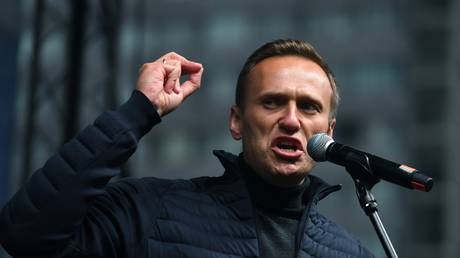
The Office of the Prosecutor General has said it will back a request by the Russian prison service to imprison opposition figure Alexey Navalny over allegedly breaking the conditions of his probation on several occasions.
On Tuesday, a court in Moscow will review a case brought against Navalny by the FSIN, the prison service. It argues that his suspended prison term needs to be replaced with a real one, because throughout the previous year, he has not followed the terms of his probation. The Prosecutor General’s Office told journalists on Monday it supports the request.
In 2014, Navalny was sentenced to a suspended term in an embezzlement case, which also involved his brother. He claims the charges against them were fabricated for political reasons.
The probation period expired at the end of 2020. According to the FSIN, Navalny failed to show up last year to confirm his status several times before leaving Russia in August for medical treatment. After being released from a German clinic in September, he failed to inform his probation supervisor about his whereabouts in due order, the case alleges.
Navalny is also the subject of a defamation case over remarks he made last June about people supporting amendments to the Russian Constitution, including a 94-year-old WWII veteran.
The opposition activist called the people “sellouts.” The yet-to-be-resolved case may be considered by the judge as relevant to Navalny’s probation situation.
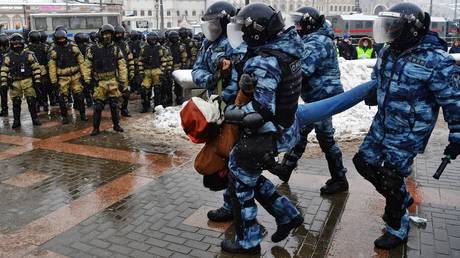
The anti-corruption activist left Russia after what he believes to be an attempt on his life by Federal Security Service (FSB) agents. He was arrested on January 17, the day he returned to Moscow, at the FSIN’s request. His supporters have staged protests in numerous Russian cities for two consecutive weekends, demanding his release. The Russian government has denied it attempted to kill Navalny, and said he was working with foreign intelligence services to smear the country.
Think your friends would be interested? Share this story!
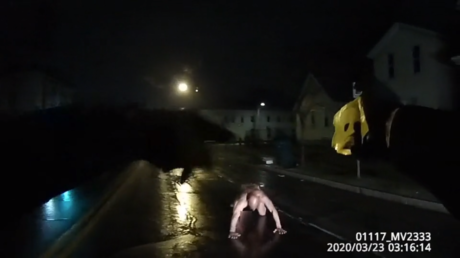
An internal review was launched after a police officer was filmed pepper-spraying a minor who was sitting in the back of a patrol car. Police claimed the girl was suicidal and threatened to kill her mother.
A minute-long bodycam video shows a girl in handcuffs sitting in the back of a police car. She is distressed and does not appear to be following the officers’ commands. The clip was edited to blur the girl’s face.
“Come on. I’m gonna pepper spray you, and I don’t want to, so sit back. Come on, this is your last chance, otherwise pepper spray is going in your eyeballs. Come on, let’s go,” an officer says.
“I want my dad,” the sobbing girl pleads, to which a female officer replies: “I’m gonna go get him.” She adds: “I will fix it,” apparently referring to the cuffs.
Another officer joins in, asking the girl to “just stop for a second and take a deep breath.”
She is then heard screaming: “Please no! Stop!” The officer soon takes out a spray can and points it at the girl’s face.
“It went into my eye! Please!” the girl yells, as the officer is heard telling his colleague: “I got her, I got her.” He then closes the car door from the outside, steps away from the vehicle and lets out a sigh. He calmly adds: “Unbelievable.”
Warning: This footage contains scenes that some viewers may find distressing.
According to the local newspaper Democrat and Chronicle, police were called in for “family trouble” involving a potentially stolen vehicle. They were then approached by the custodial parents of the girl, who said she feared that the minor would hurt herself and others. The girl was said to have run away from home before being apprehended on a nearby street.
Police said the minor became “agitated” and began to pull away and kick the officers when she saw her custodial parent. The girl was then handcuffed for her own “safety,” and at the request of the parent. The child remained non-compliant, refusing to put her feet in the car, which “required an officer to use an irritant on the minor,” police said.
The girl was then taken to a hospital and later released to her family.
Rochester Police Captain Mark Mura said that the incident is currently under review. He explained that the initial call was about a woman having a dispute with her boyfriend who took her vehicle from the home.
At a news conference on Sunday, Rochester Deputy Police Chief Andre Anderson told reporters that the girl had “indicated she wanted to kill herself and she wanted to kill her mom.”
At the same time, Rochester Interim Police Chief Cynthia Herriott-Sullivan said, “I’m not going to stand here and tell you that for a 9-year-old to have to be pepper-sprayed is OK.”
Mayor Lovely Warren earlier said she was “deeply troubled” by the incident, and has directed the police to carry out a “thorough investigation.”
“This is not something that any of us should want to justify, can justify,” Warren said. “And it is something we have to change.”
Several city councilmembers said they were equally shocked and angered by the way police treated the minor.
“NINE?! How afraid of a handcuffed 9 year old girl were they that they needed to pepper spray her?” councilmember Mary Lupien tweeted. “Having been pepper sprayed I can attest that this incident will change her life. There will be accountability for this.”
NINE?! How afraid of a handcuffed 9 year old girl were they that they needed to pepper spray her? Having been pepper sprayed I can attest that this incident will change her life. There will be accountability for this. https://t.co/BRomWZxvCE
Demond Meeks, a member of the New York State Assembly, tweeted that the officers should be fired for their conduct.
Police contract be dammed, I want these police officers fired TODAY. There is no excuse to mace a 9-year-old girl, a child who was helplessly handcuffed & in your control. Enough with the platitudes & enough w/ “good intentions”. Action today.https://t.co/4rNgIgtqrX@RochesterPAB
Aung San Suu Kyi, the leader of Myanmar’s National League for Democracy Party, has reportedly called on her countrymen to demonstrate against the military’s bid to seize power, following reports of her detention.
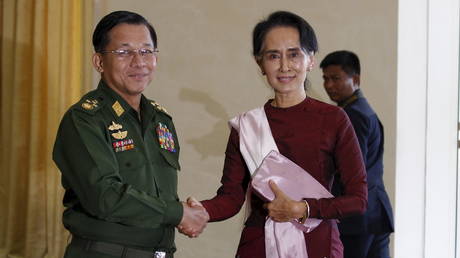
Myanmar’s military declared a state of emergency on Monday morning over allegations that NLD’s landslide victory in November’s parliamentary election was illegitimate. A military-owned television broadcaster announced that the commander-in-chief of the Myanmar Armed Forces, General Min Aung Hlaing, would be taking control of the country for one year, invoking a state of emergency as part of the military’s far-reaching powers under the constitution.
A statement released by the NLD and signed by Suu Kyi denounced the military’s actions as an attempt to “put the country back under a dictatorship,” and called on the people of Myanmar to reject the move.
I urge people not to accept this, to respond and wholeheartedly to protest against the coup by the military.
The statement was issued by NLD chairman Win Htein, who claimed that the call for protest from Suu Kyi was genuine.
The military, known as the Tatmadaw, has not commented on the whereabouts or status of Suu Kyi, who was, along with Myanmar’s president, Win Myint and several other high-ranking officials, reportedly detained earlier today. A spokesperson for NLD said the party’s leader was “taken” and escorted away.
Tensions between the NLD and the Tatmadaw have been mounting since November’s vote, which gave Suu Kyi’s party 396 out of 476 seats in the bicameral parliament. The military-backed Union Solidarity and Development Party was only able to secure 33 seats.
Following the election, the military has repeatedly insisted that the blowout victory was the result of widespread fraud, alleging that voter lists contained as many as 8.6 million irregularities. However, the country’s election commission ruled last Thursday that there was not enough evidence to support the military’s claims.
The state of emergency comes just days after Myanmar’s military denied that it was threatening to stage a coup over the disputed election, saying media reports had misinterpreted warnings issued by the Tatmadaw. Last week, a military spokesman warned that the army was about to “take action” and implored observers “to wait and watch.”
The Southeast Asian nation had previously been under five decades of military rule.
Washington has demanded the immediate release of government officials in Myanmar after de-facto civilian leader Aung San Suu Kyi and others were reportedly detained by the military ahead of the first meeting of the new parliament.
“The United States expresses grave concern regarding reports the Burmese military has detained multiple civilian government and civil society leaders. The military must reverse these actions immediately,” US Secretary of State Antony Blinken said in a statement on Monday.
He called on the military leaders to “respect” the results of Myanmar’s November 8 election, which saw Suu Kyi’s National League for Democracy party securing an absolute majority in a blow to the military-backed Union Solidarity and Development Party.
The move by the Myanmar military to declare a state of emergency, citing allegations of voter fraud, drew stark condemnation from the UN as well. The secretary general’s spokesman, Stephane Dujarric, denounced the takeover in the name of election integrity as “a serious blow to democratic reform,” urging “all leaders” to promote democracy through “meaningful dialogue,” while at the same time steering away from violence.
One of the Rohingya community leaders in Bangladesh, which currently hosts around 860,000 refugees from Myanmar’s ethnic minority, has issued a call to the international community to take urgent action in view of the events.
“We urge the global community to come forward and restore democracy at any cost,” Dil Mohammad, who represented Rohingya Muslims in repatriation talks with the Myanmar government, said, as cited by Reuters.
The 2017 crackdown by the Myanmar military sparked a mass exodus of Rohingya to neighboring countries, with the majority of the refugees settling in Bangladesh camps. The military campaign prompted accusations of ethnic cleansing and genocide, which were denied emphatically by the Myanmar government. Suu Kyi, who rose to prominence as a champion for democracy and an international icon for peaceful resistance, came under fire after she effectively sided with her country’s military, dismissing accusations at the International Court of Justice in the Hague in December 2019. Although the 1991 Nobel Peace Prize Winner admitted that “disproportionate force” might have been used towards the minority, she insisted that the campaign was aimed at “insurgents” and “terrorists,” and not an ethnic group.
Myanmar military has seized power in the country, saying it’ll be in charge for a year, imposing state of emergency over what it sees as rigged elections won by the party of Aung San Suu Kyi, now reportedly under arrest.
With most of the TV broadcasting cut off amid rumours of a military coup in the making, military-owned Myawaddy TV announced Monday morning that commander-in-chief of the Myanmar Armed Forces General Min Aung Hlaing will be taking up the reins over the country for one year.
The channel reported that the military invoked a state of emergency in accordance with the constitution, which provides it with far-reaching emergency powers.
The military, known locally as the Tatmadaw, doubled down on its allegations of the voter fraud in the November general elections, citing the civilian government’s failure to investigate these allegations as one of the reasons behind the move.
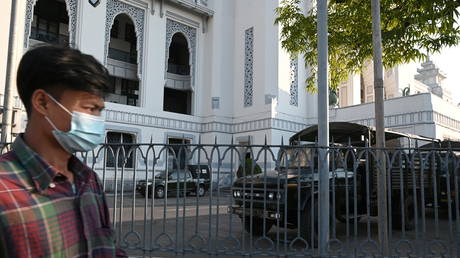
Myanmar’s residents have reported issues with internet and phone lines, and a state-run TV channel was forced to cut off broadcast over transmission problems amid reports of de-facto Myanmar’s leader Aung San Suu Kyi’s arrest.
State-run Myanmar Radio and Television (MRTV) reported early Monday morning local time that it could not stick to its regular programming schedule due to ongoing and unspecified “communication difficulties.”
This came shortly after spokesman for Suu Kyi’s National League for Democracy party announced that she and a number of other senior civilian officials had been apparently detained by the military.
"With the situation we see happening now, we have to assume that the military is staging a coup." NLD spokesman Myo Nyunt said, as cited by AFP.
There have been unconfirmed reports in the media that the military took over the channel.
Our correspondent in Yangon says that the military has just seized the government-owned national broadcaster MRTV.
Phone data has also been cut off with only wifi working now.
I'm getting reports from inside #Myanmar#Yangon that phone networks are completely down & people are afraid to go outside. Only those with Wi-Fi connection can still communicate. I've also been told (unable to confirm independently) that #military has surrounded #MRTV state TV pic.twitter.com/0JlKFMI1G9
I am in Yangon and military have taken control over the organs of state this morning. Please retweet as much as you can as we are being cut off from all the means of communications to connect outside world.
The Myanmar Times reporter John Liu tweeted that mobile internet and phone lines appeared to have been disrupted.
“Now mobile internet and phone lines are cut, only home wifi and military-operated phone line working. Having a hard time reaching my colleagues in Yangon,” he tweeted.
Now mobile internet and phone lines are cut, only home wifi and military-operated phone line working. Having a hard time reaching my colleagues in Yangon.
NetBlocks, a non-government organization which tracks Internet disruptions and shutdowns, reported a plunge in connectivity levels in Myanmar on Monday morning, saying that they dropped to some 50 percent of “ordinary levels” as of 8.00 a.m local time.
Update: Internet connectivity in #Myanmar has fallen to 50% of ordinary levels as of 8:00 a.m. local time amid an apparent military coup and the detention of civilian leaders; pattern of disruption indicates centrally issued telecoms blackout order 📵
The communication problems are taking place amid reports that a spate of high-ranking civilian officials have been detained by the military.
The government of Suu Kyi, who has been de-facto civilian leader of the country since 2015, is at loggerheads with the powerful military, known as the Tatmadaw, over the result of the November general elections that the NDL won in a landslide. Tatmadaw alleged widespread fraud, and demanded the electoral commission review the results. On Thursday, the electoral board, however, poured cold water on the claims, insisting the election had not been rigged.