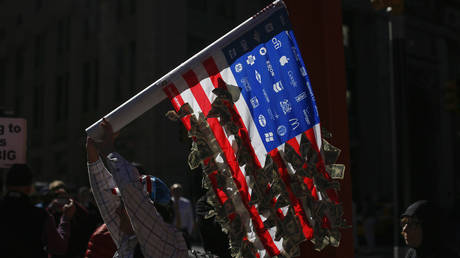
Netflix is reportedly in the running to make its own film chronicling the GameStop stock craze, after MGM also bought rights to tell the remarkable story, which saw meme-happy Redditors take on powerful Wall Street hedge funds.
Though the real-life plotline has yet to conclude, as a horde of amateur traders continue to force a multibillion dollar short squeeze on major Wall Street players, Netflix is already racing to cash in on the GameStop caper, entertainment outlet Deadline reported on Monday. The streaming service is believed to be in talks for a movie on the saga, tapping award-winning screenwriter Mark Boal and actor Noah Centineo for the project.
News of the film, which Netflix has yet to confirm, came on the heels of reports that MGM is considering its own movie, recently buying up rights to adapt a book proposal by author Ben Mezrich. While the book, set to be titled ‘The Antisocial Network,’ has yet to be written, the studio apparently moved fast to snatch up rights to bring it to the big screen, potentially setting up a race between production houses.
Netflix is also said to be in negotiations to hire NYU marketing expert Scott Galloway to consult on the script. The professor and podcaster made waves last week after offering a unique theory on what drove the GameStop phenomenon, suggesting “it’s all about sex” – or more specifically, “young men not having (enough) sex.” Though the comments stoked a wave of backlash, with many arguing that Galloway showed a profound misunderstanding of the story, that apparently has not deterred the streaming giant in pursuing his expertise.
The GameStop mania – what some have dubbed the ‘Reddit Rebellion’ – kicked off quietly at first, after members of the meme-heavy r/WallStreetBets Reddit forum noticed last year that major hedge funds were betting on the demise of certain brick-and-mortar companies and heavily short selling their stocks. The amateur traders realized if they bought up huge amounts of those shares, they could drive up their value and inflict enormous losses on the hedge funds, a process known as a “short squeeze.”
The story emerged into the headlines last week as the price for GameStop shares – as well as other shorted firms like AMC, Nokia and Blackberry – were sent soaring by the online buying craze, in some cases by more than 1,700 percent. The price surge has already imposed billions in losses on major Wall Street funds, which were forced to buy back the inflated stocks to cover what they previously borrowed for their short selling schemes. Melvin Capital, one of the Wall Street behemoths heavily invested in GameStop’s decline, alone required a bailout of some $2.8 billion from other investment firms following the Reddit-driven massacre.
Though many small-time traders continue to buy and hold the shorted stocks in hopes to do even greater damage to Wall Street fat cats, some trading platforms, such as Robinhood, have attempted to slam the brakes on the grassroots buying campaign, restricting purchases for the inflated stocks. The move may have helped GameStop’s share price collapse by 30 percent on Monday despite the ongoing short squeeze attempt. However, Blackberry and Nokia were up by some 3.4 and 7.2 percent after markets closed on Monday, while a similar buying effort has taken hold in the metals markets, potentially offering a great deal of material for the film studios as they compete to dramatize the story.
Democrats are demanding the GOP purge Georgia Congresswoman Marjorie Taylor Greene from two House committees over her supposed “inflammatory and false statements,” apparently with support of some Republicans.
Representatives Debbie Wasserman Schultz (D-Florida), Ted Deutch (D-Florida) and Jahana Hayes (D-Connecticut) submitted a resolution on Monday demanding Greene be removed from the House Education & Labor Committee and the House Budget Committee.
“Reducing the future harm that she can cause in Congress, and denying her a seat at committee tables where fact-based policies will be drafted, is both a suitable punishment and a proper restraint of her influence,” Wasserman Schultz said in a virtual news conference.
Group of House Democrats introduce resolution in the House that would remove Rep. Greene from her 2 committee assignments as a consequence for her inflammatory and false statements. https://t.co/hzCNvNvPQN
The House Rules Committee will consider the resolution on Wednesday. According to unconfirmed reports cited by several mainstream outlets, House Democrats are trying to pressure the Republican leadership into censuring or expelling Greene themselves. One Democrat has already proposed to expel Greene from the House altogether – but that seems to be a tall order, since it would require a two-thirds majority.
While Taylor Greene has enjoyed the support of high-profile Republicans, including from former President Donald Trump, some GOP leaders have echoed Democrats’ criticism of the upstart congresswoman. In a scathing statement issued later on Monday, Senate Minority Leader Mitch McConnell called Taylor Greene a “cancer for the Republican Party,” saying she’s bought into “loony lies and conspiracy theories.”
“Somebody who’s suggested that perhaps no airplane hit the Pentagon on 9/11, that horrifying school shootings were pre-staged, and that the Clintons crashed JFK Jr.’s airplane is not living in reality,” McConnell told the Hill. “This has nothing to do with the challenges facing American families or the robust debates on substance that can strengthen our party.”
Greene, who ran unopposed in her Georgia district in November, has been a target of Democrat and media criticism ever since, accused of anything from sympathy to the “QAnon” conspiracy theory to wanting to “execute” Democrat leadership. Last week, the media accused her of claiming that the school shootings in Newtown, Connecticut and Parkland Florida were staged, and that 2018 wildfires in California were caused by “Jewish space lasers.”
Rep. Cori Bush (D-Missouri), a Black Lives Matter activist also elected in November, moved her office away from Greene’s last week, claiming the maskless colleague “berated” her in a hallway and “targeted” her on social media – as well as “incited insurrection,” for which she ought to be expelled. Greene responded with a video of the altercation that showed things unfolding a bit differently.
Bush’s reference to “insurrection” – as Democrats have chosen to describe the January 6 unrest at the US Capitol – suggests the clamor about Greene isn’t just about her social media posts from long before she was a member of Congress. She is an outspoken supporter of former President Trump, and filed articles of impeachment against President Joe Biden last month, to argue the Democrats’ use of the process against Trump was purely political.
The template for Greene’s ouster appears to be the January 2019 purge of Steve King (R-Iowa) after a New York Times article accused him of racism. Republicans were eager to denounce King back then. This time, however, there is no sign that the Democrats will stop with Greene.
Bush is one of many lawmakers – including the firebrand Alexandria Ocasio-Cortez (D-New York) – accusing Senators Josh Hawley (R-Missouri) and Ted Cruz (R-Texas) and some 147 Republican members of the House who dared raise the question about irregularities in the election of Joe Biden of “insurrection” and calling for their resignation or expulsion from Congress.
Multiple senators have acknowledged that Democrats are looking at the 14th Amendment – used to disenfranchise Confederates after the Civil War – as a tool against Trump and his supporters.
If you’re defending yourself against the things someone who hates you is saying about you, you’ve already lost.
The French government remains divided on whether to implement a third national lockdown, with the country’s finance minister calling it “the very last option” which would be very harmful for France’s economy.
Speaking to RTL radio on Monday, Finance Minister Bruno Le Maire argued that the existing 6pm to 6am curfew measures are delivering results in containing the virus. A full-blown lockdown, which would be the third one for France over the course of the coronavirus pandemic, must be implemented only when all the other options are exhausted.
“Lockdown can only be the very last option, when all the others have been used, because lockdown puts pressure on the morale of the French… it also puts pressure on public finances,” the minister stated.
A full lockdown would cost France’s economy around €15 billion ($18.1 billion) a month, while the existing curfew measures only cost around €6 billion, Le Maire said.
The finance minister’s assessment of how to handle the coronavirus situation, however, appears to be quite the opposite of what some of the country’s health experts believe. Speaking to BFMTV on Monday, Eric Caumes, the head of infectious diseases at the Paris hospital La Pitie-Salpetriere, said the government’s decision to stick to curfews instead of a full lockdown is a “big risk.” He also said the epidemic situation varies across the country, and that the situation in Paris is concerning.
We see the curve going up, so we are very worried.
A similar assessment of the situation was made by Health Minister Olivier Veran last week, when he argued that the curfew measures were no longer effective in battling the virus.
“Clearly, the effectiveness of the 6pm curfew is waning and it is not enough to reverse the virus,” he stated.
Despite the existing concerns, the government still opted to prolong the curfew on Friday, while introducing additional restrictions such as shutting its borders to all traffic to and from countries outside of the EU.
France remains among the worst coronavirus-hit nations, with more than 3.2 million cases registered since the beginning of the pandemic. More than 76,000 people have succumbed to the disease across the country.
Think your friends would be interested? Share this story!
The controversial decision by Robinhood to ban the purchasing of ‘meme stocks’ came in response to regulatory demand and not any backroom dealings, the platform’s CEO has told Tesla boss and world’s richest person Elon Musk.
Robinhood’s Vladimir Tenev has become one of the most sought-after interviewees for outlets covering stock market news, due to the role he played in the stand-off between large short-selling hedge funds and a crowd of small-dollar investors from the Reddit community WallStreetBets. But Elon Musk is arguably the most unusual person to do the interviewing.
The two met over audio chat app Clubhouse on Sunday evening to discuss how the decision to throttle trading on the Robinhood app was taken. Tenev reiterated his story: after Wednesday’s surge in purchases of so-called ‘meme stocks’ fueled by WallStreetBets, the National Securities Clearing Corporation (NSCC) raised the demand for Robinhood capital deposit to a whopping $3 billion. Banning the purchases helped lower the sum to a manageable level of $700 million, which allowed Robinhood to open on Thursday.
Robinhood is a no-commission brokerage which touts itself as democratizing the financial market. The NSCC acts as a clearing house for the entire US stock trade. Brokerages have to file deposits as a means of managing risk so that they can get access to exchanges and be able to process trade orders.
Even if Tenev’s story is completely true, the liquidity fix may have been a violation of Robinhood customers’ rights, which is why a class-action lawsuit has been filed against the platform over it. On top of that, Robinhood is widely suspected of taking the decision to limit the damage done by the market rush to big hedge funds. The funds shorted heavily against companies like video game retailer GameStop, expecting their stocks to fall, and this strategy backfired when the prices instead skyrocketed last week.
Musk pressured Tenev on whether the NSCC “holding a gun to his head” was the result of hedge funds like Citadel and other market makers having a say in who is in charge of the organization. Despite its regulatory functions, the NSCC is not a government agency but a subsidiary of the Depository Trust & Clearing Corporation, a private holding.
“I have not any reason to believe that,” Tenev replied, adding that thinking otherwise gets people “into conspiracy theories a bit.” The Robinhood CEO said the NSCC deposit demand was “reasonable” under the circumstances, even if the formula they used to calculate the sum was “opaque.” Some listeners felt disappointed with his answers, even if they were amused by the person asking the questions.
1. He did not apologize.
2. He said the financial institution who imposed this upon them were "reasonable".
Musk, who in January replaced Amazon’s Jeff Bezos as the world’s richest person due to the growth of Tesla stock, was among the first people to jump on the developing GameStop story. Unlike some other wealthy individuals in the US, he is highly critical of short sellers when referring to the Wall Street vs. WallStreetBets stand-off.
The National Care Forum has warned England still has a “long road ahead” in its fight against Covid-19, despite all care home residents having been offered the first dose of a vaccine, with teams having been in 95% of care homes.
Speaking to Sky News, the chief executive of the National Care Forum, Vic Rayner, praised the success of the rollout amongst residents, although she accepted there still needs to be significant progress in vaccinating care home staff.
Last week, only 27% of care homes had vaccinated 70% or more of their staff, according to data released by the government.
“We’ve got a long road ahead and have to make sure that the government approach isn’t for a one-hit wonder,” Rayner said, urging Prime Minister Boris Johnson to ensure there is “a consistent and sustained approach over the coming months.”
Alongside the priority groups who have been identified, Rayner suggested that the government should also consider expanding its targets to include individuals who regularly visit residents, provide help, or live in care homes and supported accommodation, despite not being elderly.
When the UK government began the vaccine rollout, it set a target of ensuring all members of four key priority groups, including care home residents, received the first dose of a vaccine before February 15. The nation is on course to hit that target, having given nearly nine million people the first jab and more than 491,000 people their second dose, as of January 31.
Think your friends would be interested? Share this story!
France’s economy minister has warned restaurateurs not to defy lockdown restrictions by opening their premises on Monday, adding that their plight is not “justified” despite the impact Covid-19 has had on the industry.
Speaking on Monday morning, Bruno Le Maire, France’s minister of the economy, responded to the news that many restaurant owners would be opening their doors on Monday “to draw attention” to their discomfort following months of forced closures.
Le Marie dismissed the planned action as only a few “isolated cases” and insisted their plight “in no way justifies not respecting the rules” of lockdown.
The minister claimed that those restaurant owners who do not respect the rules, which are there for the health of everyone, will see their access to government aid cut.
“Those who remain open will see access to the solidarity fund suspended for a month. In the event of a repeat offense, they will no longer have any access to the fund,” the minister announced.
One restaurant worker, Stephane Turillon, said: “The goal is to draw attention to the ill-being of restaurants and customers today.”
France imposed a state of lockdown in late October, and the government had initially suggested that restaurants might reopen on January 20.
Despite incremental relaxations of the measures, the discourse in France has very much changed, with many calling for a third full lockdown to counter high infection rates and the circulation of the more contagious British Covid-19 variant.
On Sunday, Macron defended his decision to hold off on the imposition of a third lockdown, citing his confidence in reducing infection rates without such severe curbs.
Online brokerage Robinhood has cut down the list of its restricted stocks, from as many as 50 on Friday to eight starting Monday. Trade in short-squeeze names like GameStop has been limited due to last week’s explosive rallies.
Companies that still face limitations include GameStop, AMC Entertainment Holdings, Blackberry, and others, Robinhood said, noting that the limits may be “subject to change throughout the day.”
Opening new positions in those securities is limited, according to its website, which lists the maximum number of shares and options contracts each user can hold. For those whose current holdings already exceed the limits, their positions won’t be sold or closed. At the moment, customers can only buy one share of GameStop’s stock and five options contracts.
The millennial-favored stock trading app said on Friday it had put buying restrictions in place after its clearinghouse deposit requirements for equities increased last week. “It was not because we wanted to stop people from buying these stocks,” Robinhood said.
The trading app, which is popular among retail investors who fostered the rise of GameStop stock, has been under fire for its decision to restrict trading of high-flying stocks that surged after being touted on social media.
On Sunday, US Senator Elizabeth Warren called for a broader review by the Securities and Exchange Commission on recent trading swings. She said a broker-dealer like Robinhood that invites a lot of individual investors needs to operate “under some basic rules.”
“You can’t do that in the middle of a trading cycle,” Warren told CNN about Robinhood’s trading limits. “It’s not about protecting people from making bad trades. It’s about keeping the playing field level.”
A speculative buying frenzy swept Wall Street last week due to a wave of stay-at-home traders who used social media, in this case Reddit’s WallStreetBets forum, to coordinate massive short squeezes. Shares of GameStop, a struggling brick-and-mortar video game retailer, catapulted 400 percent in the past week, closing out January with a 1,625 percent rally. The stock of American basic cable television channel AMC surged 277 percent last week, while headphone maker Koss soared more than 1,800 percent higher.
The internet is a new frontier in conflicts between Russia and the West, one of Moscow’s top politicians has warned, revealing that the country has backup plans to switch off the World Wide Web under exceptional circumstances.
Former President Dmitry Medvedev, now deputy chairman of the country’s Security Council, told local media on Monday that, as a drastic last resort, Russia could cut off access to servers beyond its borders. According to him, with the way the internet is currently set up, “the key rights to control are in the United States of America.”
“So potentially,” he added, “it could be the case that something extraordinary happens, everything completely blows up, [and] that the key to doing something about it is held overseas... Of course, we have a plan of how to act in such a situation.”
In recent years, Russia has made significant investments in developing its domestic online infrastructure, and Medvedev pointed to regulations that would allow the country to limit the web to its own autonomous networks. The politician was at pains to emphasize that these plans were contingencies, and that Russia would “really not want to” shut itself off from the digital world.
However, he argued, “since the internet is now tied to the management of the entire state, and tied to a huge number of social functions, we could not leave this without control. Therefore, there is such a law, and, if necessary, it will come into force.”
The former president also suggested that a digital proxy war was being waged on Moscow through a series of foreign-owned websites. However, he said, the country had sufficient measures in place to ensure that it could maintain access to information if social media companies censor and prohibit content made in Russia. “If they take some obviously unfriendly position towards the country, then we have the opportunity to influence them,” he added.
Social media censorship has already raised eyebrows in Moscow. In January, the Russian Foreign Ministry expressed concern over the decision of platforms like Twitter, Facebook and Instagram to ban or suspend the accounts of then-US President Donald Trump. Spokeswoman Maria Zakharova said the move “can be compared to a nuclear blast in cyberspace.” “It has been a blow to the democratic values professed by the West,” she added.
In December 2019, Russia made headlines around the world after “successfully testing” its self-contained online network. Reliant only on servers based in the country, the ‘sovereign internet’ service would act as a contingency in the case of foreign hacker attacks or a military conflict. At the time, President Vladimir Putin said that “a free internet and a sovereign internet are not mutually exclusive concepts. The law is aimed only to prevent negative consequence of being potentially cut off from the global web, which controls are located primarily abroad.”
Putin added that “we are not moving towards an internet shutdown and are not seeking to do so.”
Think your friends would be interested? Share this story!
Microsoft is ready to bolster its presence in Australia if Google follows through with a threat to pull its search engine from the country, Prime Minister Scott Morrison has said.
Australia is mulling legislation that would require Google and Facebook to pay domestic media outlets for using their content on their platforms, a move that the two tech giants strenuously oppose. Google has claimed that the licensing fees would make their services financially unviable, warning last month that the company would stop offering its popular search engine in Australia if the law goes through.
Rather than backing down, Canberra has reached out to Google’s competitor, Microsoft. The company’s search engine, Bing, is the second-most popular search tool in Australia after Google, although it currently holds only 3.7 percent of the market share. Morrison said on Monday that he has been speaking with Microsoft CEO Satya Nadella, who told the prime minister that his company was ready to ratchet up its presence in Australia should Google exit the market.
“I can tell you, Microsoft’s pretty confident, when I spoke to Satya,” Morrison said, without divulging details about their conversations. He added that Australia’s aim with the proposed content licensing legislation was to “set the rules that are right for our people,” arguing that the same regulations that exist in the “physical world” should also apply to the “digital world.”
Microsoft confirmed that it has been in contact with Morrison but declined to elaborate on their talks, noting that the company was not directly involved in the pending laws.
A spokesperson for the company said that Microsoft recognizes the “importance of a vibrant media sector” and that changing business models have created “challenges” for local news outlets.
Morrison’s disclosure of his talks with Microsoft come as Canberra continues to lock horns with tech firms over the proposed licensing fees. A day earlier, Treasurer Josh Frydenberg said that he had spoken with Facebook CEO Mark Zuckerberg about the law, but that the Australian government’s position had not changed.
The controversial legislation was drafted last July following an inquiry by the Australian Competition and Consumer Commission (ACCC), which found that a large proportion of the country’s media are reliant on referrals from Google and Facebook, despite the fact that news outlets have little control or influence over the Silicon Valley behemoths.
Facebook has urged Canberra to give it six months to negotiate directly with news outlets. Google has also signaled that it’s open to talks but has insisted that the Australian law would be unfair because it does not take into account Google’s own financial interests in the matter.
In January, Washington urged Canberra to reconsider the draft legislation, proposing a ‘voluntary’ compensation policy in its place.
Driven by nationalist zeal in the wake of the 2014 Maidan and continuing political tensions with Russia, Ukrainian authorities are moving to erase more and more of the long shared history between the two East European countries.
It appears the Russian language is now top of the target list. Earlier this month, a new law proclaiming Ukrainian as the state language came into force after being passed by the country’s parliament. As a result, employees of service sector businesses such as supermarkets, restaurants, cafes and barbershops are required to greet and serve customers in Ukrainian alone.
Only at the request of a client can they switch to another language for the sake of convenience and breaking the law will carry a fine of up to 6.8 thousand Hryvnia (almost $250) from next year. Given the average official salary is around $370 - but often far less outside the capital - this is a significant sum.
Almost one in three people living in Ukraine describe themselves as native Russian speakers, with entire cities in the east and south of the country conducting daily life in the language. Odessa, on the Black Sea coast, is well-known for its unique dialect of Russian, inspired by the Yiddish of its historical Jewish population. Only a small proportion of Odessans speak Ukrainian at home and it is unclear how well-enforced the new directive will be there.
Additionally, with their attempt to mandate how local communities express themselves, lawmakers in Kiev risk falling foul of a United Nations resolution that calls on governments to “promote the preservation and protection of all languages used by peoples of the world.” Ukraine has previously depended on support from friendly states in the UN over issues like Russia’s reabsorption of the Crimean Peninsula in 2014, and there are no signs yet as to whether the international body will take it to task over its campaign to marginalize the use of other languages.
If linguistic diversity is seen by some in the country as a challenge to their national identity, which is increasingly being defined in opposition to Russia, few areas of life in the country are free of politicization in this way. Ukraine, much of which historically fell under the Russian Empire, and later was a constituent member of the Soviet Union, has spent recent years working to purge symbols of that shared history in an effort to differentiate itself.
In December, a teenager was detained by an ‘anti-terror’ operative in the Western city of Lvov after buying a traditional shanks winter hat, emblazoned with the Soviet hammer and sickle, to keep his ears warm. A Russian-speaker from the East of the country, he told authorities he was unaware that Kiev had introduced tough laws banning the displaying of symbols of the USSR and the singing of its one-time national anthem, along with supposedly equivalent Nazi icons.
His confusion was understandable, given the rules appear to be selectively enforced. As recently as 2018, a notoriously murderous Waffen SS division was celebrated in Lvov, marking the 75th anniversary of the formation of the local Nazi-aligned partisan unit in WWII. Nationalists, dressed in SS attire and exhibiting swastikas, marched through the streets with no police response.
Many nationalists continue to glorify the Ukrainian partisans who fought alongside the Nazis against the Soviet Red Army in the name of forming an independent state aligned with the Third Reich. For them, figures like Stepan Bandera were the founding fathers of the movement for Ukrainian nationhood. Others, however, point out the far-right leader’s links to massacres of ethnic Poles and hold him responsible in part for the wartime Holocaust in the country.
Last October, nationalist campaigners in the predominately Russian-speaking city of Odessa launched a series of protests aimed at toppling a statue to Catherine the Great, the Russian empress under whose reign the city had been built. In her place, they said, they wanted to install a monument to Bandera.
A spokesperson for the protesters told the local newspaper Public that “our initiative has the goal of getting rid of all the manifestations of Russian influence that remained after the colonial period in our history. In order to look to the future, we need to break all these ties and move our own way.”
Of course, the close historical ties between Russia and Ukraine can’t simply be expunged for political convenience. In the case of the statue in Odessa, funds had been raised to restore it by the local business community in honor of the founding of the city. Likewise, as well as a large Russian-speaking population, much of the country’s history is closely intertwined with that of its vast Eastern neighbor, first under Imperial rule from Moscow and then as prosperous part of the Soviet Union. To divorce themselves from Russian history, the nationalists must entirely rewrite that of their own country.
As much as Russia has shaped Ukraine’s history, prominent Ukrainians once played a leading role in setting the course for the whole USSR. Former Soviet Premier Leonid Brezhnev, born in modern-day Ukraine, and who self-identified as a Ukrainian, led the union for close to two decades. His predecessor, Nikita Khrushchev, was born near the present-day border and moved as a child to Donetsk, in an example of how the current borders are often out of step with historical and cultural realities. That, however, does not stop them being the subject of fierce fighting between those who seek closer ties once again with Russia, and others whose politics is defined by the Ukrainian nationalist movements.
Ukrainian President Volodymyr Zelensky, while not personally linked to nationalist groups, in the past, has increasingly made plays for their support to shore up his tentative hold on power. Faced with regional rebellions over coronavirus lockdown laws and a burgeoning constitutional crisis over corruption rules, taking shots at Russia has proved a popular tactic.
However, it now appears that millions of Russian-speaking Ukrainians are in the firing line.
Think your friends would be interested? Share this story!