Former Green Party candidate Jill Stein has won a grueling four-year legal battle to inspect the software running Wisconsin’s voting machines and publish what her team finds – but too late to run the analysis before 2020’s vote.
The Stein 2016 Recount Campaign finally crushed an attempted gag order by machine mega-manufacturer Election Systems & Software, they announced on Friday, winning the right to inspect the source code of the machines used in Wisconsin and release her team’s conclusions about the accuracy and reliability of the software to the public.
BIG NEWS: the #Recount campaign has won our court fight in Wisconsin, overcoming the final obstacle to a groundbreaking examination of voting machine source code by defeating voting machine vendors' attempts to gag us from telling the public what we find.https://t.co/GKjsxRYrPB
While the ruling represents a decisive defeat for ES&S – one of the largest makers of the devices in the US – it came too late to conduct any inspection before next week’s presidential election, Stein lamented.
It’s outrageous that voting machine vendors that profit from government contracts have been able to use those profits to buy political influence and prevent scrutiny of their machines through legal machinations.
“This is a major win for voters everywhere,” she nevertheless said. Stein’s designated expert, University of Michigan Computer Science and Engineering professor Dr. J. Alex Halderman, also praised the opportunity for “independent scrutiny.”
The ex-candidate began her recount crusade following President Donald Trump’s November 2016 victory, demanding a recount in Wisconsin, Michigan, and Pennsylvania. Stein’s 2018 settlement with the state of Pennsylvania required it to replace paperless voting machines with alternatives that leave a paper trail by 2020, with an extra round of audits added by 2022. The suit against Wisconsin also caused the state to decertify one model of voting machine that was caught miscounting ballots during the partial recount her legal actions secured, and the recount itself revealed one in every 170 votes had been “miscounted.”
Stein had less luck in Michigan, where the recount was squelched before it was complete – though not before her revealing the state had placed dodgy machines in urban districts, leading to over 80 ballot scanner breakdowns on Election Day and snarling efforts to untangle the matter in arcane legal red tape.
Despite raising millions of dollars to have votes recounted with the stated purpose of helping “create fair elections,” Stein is loathed by many of the Democratic faithful, who blame her – along with failed Democratic presidential candidate Hillary Clinton’s rival Bernie Sanders, WikiLeaks co-founder Julian Assange, Russian President Vladimir Putin, and a hefty portion of the American electorate – for Clinton’s loss. The physician, who also ran for president on the Green ticket in 2012, opted not to run again in 2020, perhaps weary of being blamed for the failure of other candidates.
Voting machine manufacturers don’t help the generally low level of trust in their products by refusing to disclose who actually owns them, as several voting machine suppliers declined to do when asked by the North Carolina Board of Elections last year. ES&S briefly merged with competitor Diebold in 2009, creating a de facto monopoly before the federal government sued the megacorporation for antitrust violations, forcing it to spin off one company’s assets. Diebold in turn was notorious for alleged collusion with the Republican Party, returning results favorable to the GOP under dodgy circumstances in 2000, 2002 and 2004.
Most states’ voters in 2020 have the option of voting by mail if they prefer due to the coronavirus pandemic, though that method has been criticized and fraught with various problems. From “wrong” ballots, to mysteriously discarded votes, to dead people receiving ballots, it’s not much of a surprise that a recent poll found just 15 percent of Americans had faith in US democracy.
Members of the right-wing organization Generation Identity held a vigil outside the church that was the scene of the horrific terrorist attack in Nice on Thursday, in which three people were killed, two of whom were decapitated.
Scores of Identitarians gathered at 19:30 local time to lay a wreath in front of the church, observing a minute’s silence in honor of the victims and their families, before singing La Marseillaise, the French national anthem.
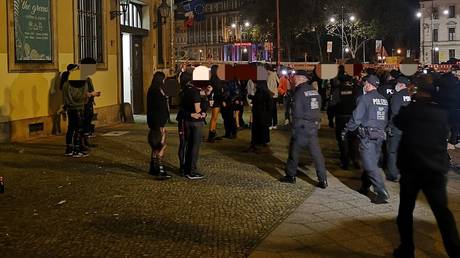
Eyewitness footage from the scene shows the group marching through the streets of Nice’s Notre-Dame district which bore witness to the carnage in Thursday morning’s attack. Members waved flags and banners as they marched. Though there was a heavy police presence, no clashes or incidents were reported.
For some, the mere sight of identitarian groups marching through streets drew comparisons with the Hitler Youth.
Donc ça c’est #Nice 10h après l’attentat qui s’est déroulé dans Notre-Dame, depuis ma fenêtre
This was also the scene for a short time on Thursday evening outside Notre Dame church in #Nice. A crowd of around 100 men, waving flags and singing the French national anthem. Some chanting the far right slogan “on est chez nous” (translation ‘this is our home”) pic.twitter.com/IEc3jS7h4W
Elsewhere on Thursday, a supposed member of the anti-immigraion group was shot dead by police after refusing to lay down his handgun with which he had threatened various members of the public.
Police fired non-lethal munitions initially but the suspect reportedly lunged at them at which point they opened fire with live ammunition, killing him.
Tensions within French society have been mounting since school teacher Samuel Paty was decapitated by an Islamist terrorist earlier this month, after he showed Charlie Hebdo cartoons depicting the Prophet Mohammed to his students. The shocking killing prompted France to increase security at religious sites and wage a “battle against Islamist ideology”.
Think your friends would be interested? Share this story!
Philadelphia's mayor has ordered a 9pm curfew for the second time in three nights to help quell riots, but he is delaying release of police bodycam footage of the shooting that led to the unrest until after the election.
The curfew will be in place until 6am Saturday, and only those who are going to work, seeking medical assistance or dropping off a mail-in ballot will be allowed to leave their homes, the city announced on Twitter. A similar curfew was imposed for Wednesday night, after Black Lives Matter protests escalated into riots that left 53 police officers wounded, dozens of businesses looted and ATMs around the city blown up on Monday and Tuesday.
A few updates on the recent unrest in our city and the safety preparations we are making: First, I have authorized a citywide curfew which will go into effect tonight at 9 p.m. through tomorrow at 6 a.m. https://t.co/vkiGux5tUL
The protests began after two police officers fatally shot a knife-wielding black man named Walter Wallace Jr. on Monday. Video recorded by a bystander shows the officers backpedaling as the 27-year-old Wallace moves toward them and ignores their commands to drop his knife.
Philadelphia Fraternal Order of Police President John McNesby asked Wednesday that city officials quickly release all available evidence on the shooting to “support your officers, back your officers, and let's get a handle on this thing.” But Mayor Jim Kenney said Friday that he and the Wallace family agreed to release the bodycam footage and 911 audio of police being called to the scene on Nov. 4 “in the hope that it will provide enough time to ease tensions and release the recordings in a constructive manner.”
Kenney gave no explanation for why the day after Tuesday's election, specifically, was chosen for the release. The Wallace family, Kenney, Philadelphia's police commissioner and District Attorney Larry Krasner all agreed that releasing the evidence on Wednesday “is in the best interest of our city and its residents,” according to a joint statement.
Kenney has sought to appease protesters by blaming the unrest on “systemic racism” and promising actions to “bring true equity to our city.” Krasner was elected in 2017 with the help of $1.45 million in funding from billionaire George Soros and fired 31 prosecutors in his first week on the job as part of his plan to bring “transformational change” to Philadelphia's criminal-justice system.
The second curfew was ordered just as hundreds of Pennsylvania National Guard troops were setting up their positions in the city after being deployed by Governor Tom Wolf earlier this week. Kenney said the troops will be staged at government buildings and other infrastructure and may be sent to other key areas, such as business areas, as needed. He said their presence is unrelated to Tuesday's election, and the need for their continued deployment will be reviewed on a day-to-day basis.
The delay in releasing bodycam footage and 911 audio marks just the latest blow for Philadelphia police, who have been pelted with bricks and rocks this week and have seen at least 17 emergency vehicles torched or otherwise damaged. One officer was purposely run over by a large pickup truck. And Thursday, the City Council voted to ban police from using tear gas, pepper spray and rubber bullets during protests, leaving officers few options for non-lethal crowd-control tools.
Think your friends would be interested? Share this story!
EU member states will be allowed to use only official EU-approved Covid-19 vaccines, Brussels said in response to remarks by Hungarian Prime Minister Viktor Orban that Budapest was negotiating for shots with Russia and China.
“There is no question that any vaccine that is, or could be, made available on the territory of the European Union would have to comply both with the quality standards that are expected for these types of products in the EU and follow the approval procedures” currently in effect, European Commission spokesman Eric Mamer said at a press conference on Friday, asked about Orban’s comments.
While not calling out Orban by name, Mamer’s comments came after Hungarian PM said Budapest was talking to Beijing and Moscow and hoping to have two to three different vaccines by early next year.
The first shipment of vaccines should arrive in December or January, and Hungary will be able to “declare victory over the pandemic” by next spring, Orban said Friday in a radio interview.
It appears that Brussels will not allow Hungary to do so, however, as the bloc has signed agreements with AstraZeneca, Sanofi-GSK, and Johnson and Johnson for “safe and effective vaccines” against the coronavirus, once they complete the clinical trials.
“We are not in negotiations with either Russian or Chinese companies,” Mamer added. “That is the European vaccine strategy. All member states have signed up to this process.”
Johnson & Johnson had paused its trials in mid-October, citing an “unexplained illness” in one of the participants. AstraZeneca had also halted their trials over a UK volunteer experiencing complications, but restarted them even after a Brazilian volunteer died on October 20.
Russia was the first in the world to register a coronavirus vaccine. Dubbed ‘Sputnik V,’ it is based on the adenoviral vector platform previously studied and considered safe, and is currently undergoing phase three trials. Moscow has applied for the World Health Organization’s (WHO) Emergency Use Listing program, which would allow accelerated approval of the vaccine for use.
Brussels and Washington have objected to the Russian vaccine, ostensibly on the grounds of safety. The US also appears to have leaned on governments to pressure them away from ‘Sputnik V’. On October 16, the US embassy in Kiev announced that Ukraine “will NOT be buying Russia’s [Covid-19] vaccine, which has not passed clinical trials for safety!”
Meanwhile, Philippine President Rodrigo Duterte has expressed distrust of Western pharmaceutical companies, accusing them of being “all about profit.” Duterte said he would seek a deal to buy the vaccine from China or Russia, which Manila was prepared to pay for.
Some 2,000 doses of the Russian vaccine were sent to Venezuela in early October, after the authorities in Caracas asked for help due to US and EU sanctions ravaging the country’s healthcare system.
The virus, which was first detected in China in December 2019, quickly spread around the world, with the WHO declaring a pandemic in March. Almost 45.5 million people have been infected so far, with 1.18 million deaths attributed to the virus. Much of Europe and the US have locked down in an effort to slow the spread, with disastrous economic consequences.
The EU’s Mamer did acknowledge that “at some point” vaccines produced outside the bloc “may” be considered for distribution, but declined to elaborate.
Brazilian President Jair Bolsonaro has condemned the fresh wave of lockdown measures employed by countries around the world to combat surging cases of Covid-19, blasting them as “crazy.”
Bolsonaro, a prominent coronavirus skeptic who has repeatedly argued that the economic impact of anti-Covid-19 measures outweighs the dangers of the virus itself, launched a new attack on the restrictions late on Thursday.
The measures many countries across the world have taken in wake of the second wave of the pandemic are nothing but “crazy,” the president said, as he refused to fund clinical trials of a Chinese-made coronavirus vaccine in Sao Paulo state.
“Dear Sao Paulo Governor [Joao Doria], I know you're passionate. You know this but no one is going to take a forced vaccine, it would be difficult,” Bolsonaro said, adding that he was “not going to buy your vaccine.”
Earlier this month, Joao Doria, the governor of the most populous Brazilian state and a Bolsonaro opponent, promised that the Covid-19 vaccination would be compulsory for its residents. Bolsonaro said at the time that the Health Ministry would provide vaccination “without making it mandatory,” arguing that by law it was up to the federal government to decide whether to make the vaccination compulsory or not.
Over the course of the pandemic, the Brazilian president has repeatedly had run-ins with the country's health and state authorities as he advocates for a laissez-faire approach to the crisis. Bolsonaro’s critics, however, accuse him of downplaying the extent of the pandemic.
Bolsonaro himself has contracted Covid-19 and he successfully recovered from the disease back in July. The president has publicly defied anti-coronavirus rules, appearing in public without a face mask and socializing with his supporters without any social distancing.
Brazil is the third worst affected nation in the world – after the US and India – with nearly 5.5 million confirmed Covid-19 cases and almost 160,000 deaths.
Think your friends would be interested? Share this story!
Walmart has reversed course on a decision to yank firearms and ammunition from sales displays less than 24 hours after announcing the move amid a spate of looting in US cities. The company now says the unrest remained “isolated.”
The retail giant noted the about-face on Friday, saying guns would be returned to store shelves just one day after they were pulled, initially deemed a precautionary measure as heated anti-police brutality protests across the country erupted into riots and looting.
“After civil unrest earlier this week resulted in damage to several of our stores, consistent with actions we took over the summer, we asked stores to move firearms and ammunition from the sales floor to a secure location in the back of the store in an abundance of caution,” a company spokesperson said in a statement.
As the current incidents have remained geographically isolated, we have made the decision to begin returning these products to the sales floor today.
Demonstrations in Philadelphia this week over the fatal police shooting of Walter Wallace Jr., a black suspect killed during a confrontation with officers, ignited several days of rioting and unrest in the city, which saw at least one Walmart location targeted for looting.
It is unclear what prompted the abrupt reversal from Walmart, as its announcement on Thursday also referred to “isolated civil unrest,” however as protests have begun to calm in Philadelphia and National Guard troops hit the streets, the company has apparently determined its vast cache of firearms and munitions is safe from plunder.
Fact-checkers appear to have been invoked only as an excuse to shadowban the New York Post story about Hunter Biden’s laptop, according to Facebook’s own statement and leaked internal moderation documents.
Earlier this month, the Post had obtained a hard drive belonging to the son of the current Democratic presidential nominee Joe Biden, and cited emails they found as indication of troubling business deals in Ukraine. Twitter responded by locking their account, but Facebook said it would “temporarily reduce distribution” of it.
According to Andy Stone, Facebook’s policy communications director, the story would have to be looked at by fact-checkers, which was part of a “standard process” to reduce the spread of “misinformation.”
On Friday, however, a Facebook statement seemed to confirm that no such review actually took place.
“As our CEO Mark Zuckerberg testified to Congress earlier this week, we have been on heightened alert because of FBI intelligence about the potential for hack and leak operations meant to spread misinformation,” a company spokesman said in a statement to the Guardian. “Based on that risk, and in line with our existing policies and procedures, we made the decision to temporarily limit the content’s distribution while our fact-checkers had a chance to review it.”
When that didn’t happen, we lifted the demotion.
The spokesman did not clarify whether the fact-checkers even attempted to verify the materials published by the Post, but no results of such a review have ever been published.
Moreover, the Guardian cited internal moderation documents that someone at Facebook leaked to them, indicating that the shadowban wasn’t part of a regular process. Instead, the documents purportedly showed the existence of a policy under which stories can be “manually enqueued” for suppression, citing the upcoming US elections as an “issue of importance” that justified such actions.
Who elected these people guardians of what is true?Facebook leak reveals policies on restricting New York Post's Biden story | Technology | The Guardian https://t.co/Tbng1r4Cdf
The documents also say that the standard practice is for Facebook AI to predict which content might contain misinformation, based on signals “including feedback from the community and disbelief comments,” in a sort of pre-crime enforcement straight out of dystopian science fiction.
There is also a de-facto “whitelist” of some 5,000 media outlets, called the “Alexa 5K,” whose content the AI ignores by default “under the assumption these are unlikely to be spreading misinformation.” The Post was apparently on that list, so the decision to suppress the story was made by actual Facebook employees, not an AI system flagging potential misinformation.
It worked, too. Data compiled by research firm NewsWhip and published in Newsweek last week showed that Facebook’s soft suppression was far more effective than Twitter’s outright censorship of the Post’s account, which was finally overturned on Friday.
On Facebook, the story reached only half as many readers as similar anti-Trump bombshells pushed by the mainstream media. Neither the claims by the New York Times about the president’s taxes nor the Atlantic’s repeatedly-refuted story about Trump calling US troops “suckers and losers” were flagged for fact-checking by either human moderators or Facebook’s AI.
Stone, Facebook’s policy director who announced the shadowban, is open about his history with the Democrats. His Twitter biography shows him working in the past for the Democratic Congressional Campaign Committee, Senator Barbara Boxer and Rep. Jerry McNerney, among others.
The ongoing protests against Covid-19 restrictions threaten “internal security,” Thuringia PM Bodo Ramelow told German media, suggesting terrorism and pogroms were taking shape at the hands of a right-wing/‘anti-vaxxer’ alliance.
The massive demonstrations against Berlin’s tightening pandemic control measures are starting to resemble “terrorism,” Ramelow told Tagesspiegel on Thursday, insisting the protests – and the fringe interests they brought together – were “a threat to internal security in our country.”
Ramelow, who is a member of The Left (Die Linke), pointed to a protest in which some marchers carried large photos showing Chancellor Angela Merkel and virologist Dr. Christian Drosten in concentration camp uniforms and chanted for them to be hung from lampposts as evidence the opposition to Merkel’s coronavirus regime was getting out of control.
Especially dangerous has been the way in which the demonstrations bring together far-right “Reichsburgers” (a fringe group of German monarchists) with “lateral thinkers” (Querdenken, a reference to a free-thinker group that has organized numerous protests against lockdowns) and “corona-deniers” with “anti-vaccination activists,” Ramelow continued.
The volatile mixture, he said, was “very dangerous.” He dismissed the notion that Germans would be vaccinated against their will and seemed disturbed that anyone would even consider the idea that Microsoft founder and billionaire vaccine evangelist Bill Gates was “now trying to force-vaccinate us.”
I observe pogrom-like moods in all these networks and conspiracy myths.
In the interview, Ramelow attempted to link last weekend’s arson attack on the Robert Koch Institute, Germany’s federal disease control agency, to the anti-lockdown movement. However, the attackers – who were seen by security guards throwing molotov cocktails at the facility – have not been caught and no evidence has been produced to indicate a political motive. The facility was reportedly targeted with a distributed denial of service (DDoS) attack by hackers several days before the firebombing.
The leftist politician also sought to link the anti-lockdown protesters to a bizarre act of vandalism earlier this month on Berlin’s Museum Island, a crime German media strove to pin on conspiracy theorists and the QAnon movement. Dozens of artworks and artifacts, including a reconstruction of an ancient Greek Pergamon altar, were defaced with an unknown “oily substance.”
Ramelow claimed the beliefs of the anti-lockdown protesters were part of an insidious undercurrent of “irrationalism” which was responsible for wild stories about the island.
“They say the Pergamon Altar is the Witches’ Sabbath,” the politician pointed out. Indeed, “they” say much more than that – former vegan celebrity chef Attila Hildmann has claimed that the altar is actually the nexus of the “global satanism scene,” even accusing Chancellor Angela Merkel of performing “human sacrifices” on it with her globalist pals. It is unclear how all this is related to the anti-lockdown protests, however.
German officials have sought to label anti-lockdown protesters as security threats before, in particular after the August incident in which a small faction of protesters marching in Berlin leaped over metal barricades and evaded riot police to “storm” the Reichstag building. To add to the political outrage that followed, some of the intruders were brandishing the imperial German flag popular with the Reichsburgers.
While the splinter group received the lion’s share of media attention, including grandstanding denunciations from Merkel’s Christian Democratic Union and its political allies, this happened during a much larger demonstration. Tens of thousands more protesters massed near the Brandenburg Gate to show their opposition to the strict controls placed on Germans amid the pandemic, and mass protests mostly went without incident.
While Merkel pledged late last month not to enact a second economy-destroying nationwide lockdown, her government has steadily been applying more pressure as cases creep up. A partial lockdown is set to take effect next week, with restaurants, theaters, gyms, and swimming pools closing and private gatherings limited to 10 people. Schools will remain open.
Berlin has pointed to a steep uptick in Covid-19 cases to justify the crackdown, even though the rise has not been accompanied by a surge in deaths as happened during the initial wave of cases. A Bavarian testing lab was found to be churning out a stream of false positives earlier this week, with 58 of 60 tests wrongly diagnosed as infected. Economic Minister Peter Altmaier downplayed the issue, suggesting it was only a problem at that one facility.
Notorious for its extraordinary traffic congestion, Paris outdid itself on Thursday evening, with a record-breaking 700km traffic jam as residents fled the capital ahead of the second coronavirus lockdown.
Many Parisians apparently opted to spend the impending lockdown in the countryside, in scenes reminiscent of the first lockdown earlier this year, before which residents fled the major population centers. Eyewitness footage from the French capital captured the chaos.
Incredible traffic jam in Paris as people try to leave the city before 9 pm curfew and before confinement begins at midnight. Traffic is barely moving in every direction as far as the eye can see. Lots of honking and frustrated drivers. pic.twitter.com/6Zn2HCxuPl
Boulogne 20h40. En #SMUR sirènes et gyrophares.
Y’a t’il une connerie qu’il n’ont pas faite?? On peu pas accuser le gouvernement. #deuxiemevague#confinementSaison2 750km de bouchon à 18:00, 350km à 20:40.
Mais quels cons... y’a pas d’autres qualificatifs possibles 🤬 pic.twitter.com/UP6FPKPwEv
According to France’s traffic department, jams throughout the Ile-de-France region stretched out over 430 miles (700km) on Thursday evening ahead of the country’s second lockdown, which came into force at midnight on Friday amid a surge in coronavirus cases. There were 47,637 new cases and 250 new deaths reported on Thursday alone.
Similar tailbacks were reported around the cities of Lyon and Bordeaux in the hours prior to the lockdown taking effect.
Dernier passage avant un moment au compteur Sébastopol, qui affichait près de 11 000 cyclistes vers 19h10. On voit la voie générale vide par moment, et à la fin on voit le croisement bouché qui paralysait tout le reste de Sébastopol jusqu’à Châtelet au moins. pic.twitter.com/vS66LSCXnX
“Paris traffic is legendary but I’ve never seen anything like this,”wrote one Twitter user.
Stay-at-home orders have been issued nationwide with few exemptions for work, food shopping, and medical reasons allowed. Outdoor exercise is permitted only within 1km of home while schools will remain open, though children over six years old will be required to wear masks.
President Emmanuel Macron warned that the country could be “overwhelmed by a second wave that no doubt will be harder than the first,” as coronavirus deaths reached their highest level since April.
Despite this, eyewitness footage from the streets of Paris purports to show those left behind in the capital seizing the last opportunity to socialize before the four-week lockdown began, with streetside bars and restaurants thronged with customers.
The last pint...Bars (restaurants that are still open) are rammed in Paris... with 30 mins to go before curfew and a few hours before lockdown kicks in. This will be the last time in a while that we'll see this... Probably not what hospital chiefs want to see right now pic.twitter.com/Ea5IuBi5ms
Paris and the northeast of France were the hardest-hit areas of the country during the first wave of the pandemic. By comparison, during the second wave, the virus is spreading widely across all regions.
Think your friends would be interested? Share this story!
The yuan has continued to strengthen against the US dollar at the end of the week, rising most of all currencies in the Asia region, amid the strong recovery of the Chinese economy.
Chinese currency trading on the mainland jumped by around half a percent to 6.6789 per US dollar on Friday morning, Bloomberg data shows. The onshore yuan, officially known as the renminbi or RMB, was still up 0.3 percent against the greenback as of 7am GMT, while the offshore renminbi was up around 0.2 percent.
The appreciation of the Chinese currency comes as the world’s second-largest economy continues to rebound from the coronavirus crisis, while other major economies are still struggling to get back on track amid rising numbers of infections.
The Chinese economy expanded 4.9 percent in the third quarter, and the country’s exports and imports rose sharply in September. The yuan is set to finish October with around a 1.5-percent gain. It has strengthened significantly so far this year, rising around four percent against the dollar.
Some analysts say they see room for the Chinese currency to march still higher. According to UBS Global Wealth Management’s Dominic Schnider, “the stars are really lining up” for a stronger yuan.
“A growing current account surplus, due to stronger exports and a smaller service-balance deficit, tends to favor a stronger currency in the quarters ahead,” he told CNBC earlier this week, adding that strong economic data and the yuan “yield carry” can facilitate further growth. The yield carry refers to a strategy whereby investors make a profit on the difference between interest paid and interest earned.
The Chinese yuan may become the world’s third-largest reserve currency within 10 years, analysts at Morgan Stanley have predicted.